

Posted by Editorial Team
on October 03, 2026

Table of Contents
- Are Matching Family Outfits Good for Outdoor Events?
- Why Outdoor Settings Change the Equation
- The Verdict: Good, With Conditions
- Matching vs. Coordinating: What Actually Works Outdoors
- How to Style Matching Family Outfits Without Looking Overdone
- Best Matching Family Outfits for Photos and Events
- Tips for Family Outdoor Event Attire That Holds Up
- Weather, Fabrics, and Budget: What Competitors Skip
- Frequently Asked Questions
Last Updated: October 3, 2026
Are Matching Family Outfits Good for Outdoor Events?
Yes, matching family outfits work well for outdoor events if the fabric suits the weather and the fit allows movement. The real question is how much to match.
Outdoor settings change the rules. Indoors, a matching set is mostly a photo decision. Outdoors, it becomes a comfort and practicality decision too. Fabric weight, breathability, and layering matter as much as color.
Why Outdoor Settings Change the Equation
Outdoor events add variables indoor gatherings do not: temperature swings, sun exposure, wind, and uneven ground all affect what a family can comfortably wear for hours.
A matching set designed for a living room photo shoot may not work at a park picnic in July.
Movement is the other factor. Kids run, climb, and sit on the ground.
Pro Tip
Check the event timeline before choosing fabric. A morning event in early fall calls for a mid-weight layer. An all-day summer event calls for breathable cotton and a backup layer for the evening.
The Verdict: Good, With Conditions
Matching family outfits are good for outdoor events when three conditions are met: the fabric suits the season, the fit allows free movement, and the level of matching fits the occasion.
When those conditions are met, families get the visual payoff without the discomfort that ruins the day.
The third condition matters most. A full match is a statement; a partial match reads as intentional without feeling like a uniform, and most families find it easier to pull off and wear again.
Matching vs. Coordinating: What Actually Works Outdoors
Coordinating is the safer default for outdoor events. Matching means everyone wears the same print or color. Coordinating means the family shares a color palette, with each person in a different piece from that palette.
Coordinated looks hold up better outdoors because they give each person room to dress for their own comfort: a dad who runs warm can wear a lighter layer, a toddler who needs easy changes can wear a one-piece, and both still fit the group aesthetic.
The Pros of Going Full Match
A full match delivers the strongest visual impact. Photos look deliberate and cohesive, with no guesswork about what anyone wears, real value for holiday cards, milestone photos, or a themed event.
A full match also simplifies packing: one decision covers the whole family, which helps when managing kids, gear, and a schedule.
The Cons Nobody Mentions
The biggest downside is flexibility. When everyone wears the same piece, everyone deals with the same fabric limitations. If that fabric runs warm, the whole family runs warm.
Sizing is the second issue. A single style rarely flatters every body type equally, and extended sizes are not always available, so check the size range before committing to a full match.
Watch Out
Do not buy a full matching set without confirming the size range first. If the adult sizes stop at a medium or the kids' sizes skip a year, the match breaks and you are left with a partial set you did not plan for.
How to Style Matching Family Outfits Without Looking Overdone
The trick to styling matching family outfits is restraint: pick one shared element, such as a print or a color, and let everything else stay simple. The families who look best in photos are rarely in identical head-to-toe sets, they agree on one or two visual anchors and let each person dress around them.
Start With a Base Palette of Two or Three Colors
A base palette does the heavy lifting. Choose two or three tones that sit next to each other on the color wheel or share an undertone, then build every outfit from that set.
Reliable outdoor palettes include:
- Cream, camel, and chocolate brown
- Navy, chambray blue, and white
- Olive, rust, and warm tan
Avoid mixing warm and cool undertones in one palette. A cream that leans yellow next to a gray that leans blue reads as mismatched rather than coordinated, even when the silhouettes are perfect.
Use the 60-30-10 Rule
A common pattern in family styling is to divide color by proportion rather than by person. Give one neutral about 60 percent of the visual space, a secondary tone about 30 percent, and an accent about 10 percent.
This is why coordinating beats a full match for most outdoor events. Each person can wear the proportion that suits them without breaking the group look.
Vary Silhouettes, Not Colors
If one person wears a hoodie, another can wear a crewneck in the same palette. Shared color ties the group together while different cuts keep it from looking like a uniform. A few swaps that work well:
- Adult in a pullover, child in a zip-up in the same tone
- One person in joggers, another in straight-leg pants
- A dress or skirt for one family member, pants for the rest
Add Texture Instead of More Pattern
Texture is the easiest way to add visual interest without adding another color. Ribbed cuffs, waffle knits, sherpa linings, corduroy, and embroidery read as detail in photos without competing with the palette. If two family members are in the same solid color, put one in a ribbed knit and the other in smooth jersey so the outfits do not flatten into each other.
Age-Appropriate Styling: The Teen Problem
This is the friction most guides skip. A 14-year-old who wants to wear what their friends wear will resist a full match, and forcing it usually produces the stiff, unhappy photos parents were trying to avoid.
The workable compromise is to give teens one anchor piece and let them choose everything else.
For younger kids, the opposite applies. Toddlers and preschoolers generally do not care about the outfit itself, but they do care about comfort.
A Concrete Example
For a fall park picnic with two adults, a teen, and a toddler:
- Base palette: cream, camel, chocolate
- Adult 1: cream pullover, camel joggers
- Adult 2: camel pullover, cream joggers
That is a coordinated family look. It is not a uniform, and every person can move, sit, and eat without fighting their clothes.
Legacy Plaid Swaetshirt (Unisex) →
- Choose one shared element: a print, a color, or a single piece
- Keep the base palette to two or three tones with matching undertones
- Use the 60-30-10 proportion rule across the group
Pro Tip
Lay the planned outfits out on a bed the night before. Seeing them side by side catches clashing undertones and duplicate silhouettes faster than picturing them in your head.
Best Matching Family Outfits for Photos and Events
The best matching family outfits for photos balance a strong shared print with pieces that suit each age group.
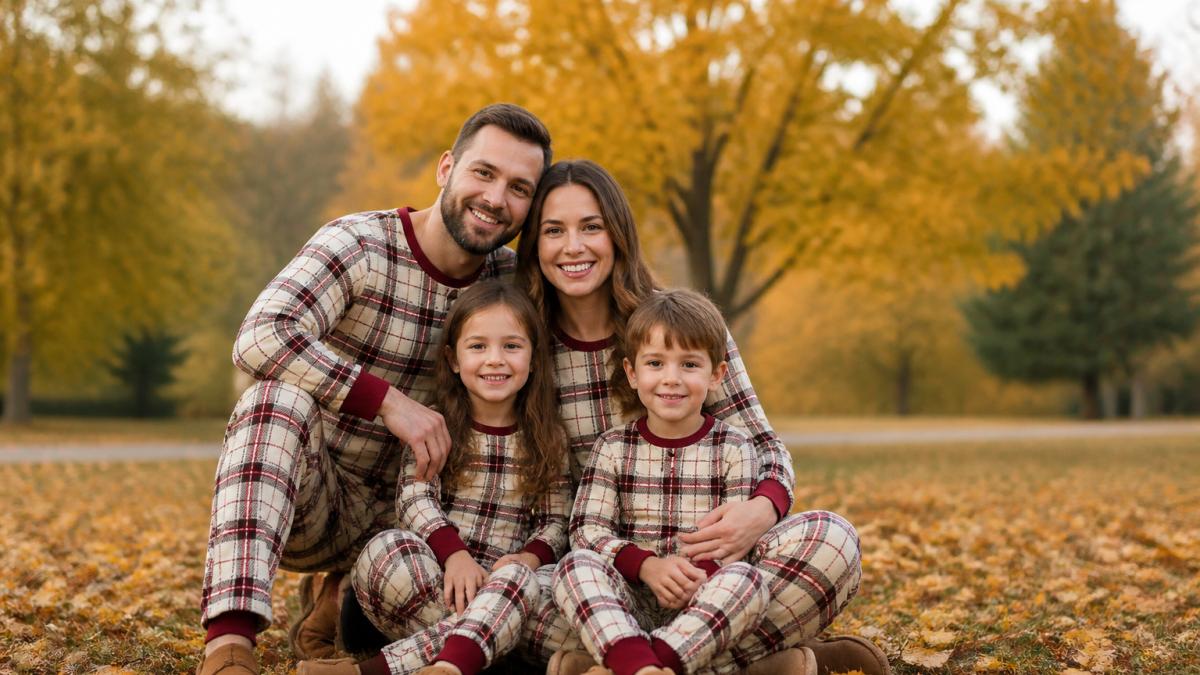
Our Legacy Plaid Sweatshirt is the anchor piece for adults.

You can bring the dog into the photo too. The Christmas Doggie Hoodie has a lined hood, ribbed sleeves and cuffs, and a harness hole, in sizes XS through XL.
What to Look For in Each Piece
| Piece | Fabric | Key Feature | Best For |
|---|---|---|---|
| Legacy Plaid Sweatshirt | 95% cotton, 5% spandex terry | Embroidered MOM/DAD/GRANDMA/GRANDPA | Adult anchor piece |
| Christmas Legacy Plaid Set (Kids) | 95% cotton, 5% spandex | Drawstring waist, side pockets | Kids who move a lot |
| Christmas Legacy Plaid Onesie (Kids) | 95% cotton, 5% spandex | Full zipper for easy changes | Babies and toddlers |
| Christmas Doggie Hoodie | 95% cotton, 5% spandex | Lined hood, harness hole | Including the family pet |
Tips for Family Outdoor Event Attire That Holds Up
Most guides treat 'outdoor event' as one category. It is not. A park picnic, a beach day, and a formal outdoor wedding have different dress codes, fabric needs, and tolerance for a full match. Getting the event type right is the single biggest factor in whether a coordinated look works.
Dress Code by Event Type
Park picnic or backyard party. The most forgiving category. Coordinated casual pieces work well: matching family t-shirts, jogger sets, or a shared palette of cotton knits.
Beach day or lake outing. Skip heavy knits entirely. Look for lightweight cotton, linen blends, or quick-dry fabrics, and choose colors that hide sand and salt.
Formal outdoor wedding or milestone event. This is where matching family outfits get risky.
Holiday or seasonal photo session. The one category where a full match earns its place.
Practical Layering for Any Outdoor Event
Build each outfit around a breathable base, then add one layer that can come off.
Test the fit before the event day. Have everyone try their pieces on and move around in them.
Pack a small kit: a stain wipe, a spare layer for each child, and a hair tie or two. Outdoor events involve grass, snacks, and wind, and a five-minute fix keeps the photos looking sharp.
A Quick Event-Type Checklist
- Picnic or backyard: coordinated casual, full match optional
- Beach or lake: shared palette, quick-dry fabric, no heavy knits
- Formal outdoor event: shared color family, formal silhouettes, confirm dress code with host
Key Takeaway
Match the level of matching to the formality of the event. The more formal the occasion, the less a full match belongs, and the more a shared color family does the work.
Weather, Fabrics, and Budget: What Competitors Skip
Most guides stop at color matching and skip the two things that actually decide whether the day goes well: fabric choice by season and cost control.
Fabric Choices by Season
Cotton blends are the most versatile choice for outdoor events.
For warmer weather, look for higher cotton content and lighter weight. Breathable fabric keeps kids from overheating, the most common reason a matching outfit gets abandoned halfway through an event.
For colder events, choose pieces that layer rather than a single heavy garment. A mid-weight set with a removable outer layer adapts to a temperature swing better than one thick piece.
Keeping Costs Reasonable
Outfitting a whole family adds up fast. A few habits keep the total manageable.
- Buy the pieces you will rewear, not just the ones for one photo
- Prioritize the adult pieces first, since kids outgrow sizes quickly
- Choose a print that works for more than one event
At Coordinates, our pieces are built to coordinate across the family, with sizes for men, women, kids, and babies, plus matching options for dogs. That range is what makes a full-family look possible without hunting across multiple stores.
American Academy of Pediatrics guidance on dressing children for outdoor weather
Consumer Product Safety Commission guidance on children's apparel safety
National Weather Service heat safety resources for outdoor events
Coordinating a family for an outdoor event takes more planning than a quick online order, but the payoff is a set of photos and a day that actually went well. The Legacy Plaid Sweatshirt, the Christmas Legacy Plaid Set, and the Christmas Doggie Hoodie are built to coordinate without forcing everyone into the same silhouette.

Frequently Asked Questions
Are matching family outfits practical for outdoor events?
They can be, as long as you prioritize breathable fabrics and comfortable fits. Cotton and cotton-spandex blends work well because they stretch and let air circulate. The main practical issue is weather: lightweight layers suit summer gatherings while heavier knits handle fall and winter. If the event involves hiking, games, or uneven ground, choose pieces that allow free movement rather than stiff, formal matching sets.
What is the difference between matching and complementary family outfits?
Matching means everyone wears the same print or color, like identical plaid sets. Complementary means each person wears different pieces that share a color palette, such as one person in cream and another in red from the same collection. Complementary looks tend to photograph better outdoors because they create visual harmony without making the group look like a uniform. Many families start with matching and shift toward complementary as kids get older.
How do you style matching family outfits without looking overdone?
Anchor the group in neutral tones and let one or two accent colors do the work. Mix silhouettes so not everyone wears the same cut: a hoodie for adults, a onesie for the baby, a two-piece set for older kids. Add small variations like different sleeve lengths or a coordinating dog hoodie. The goal is a cohesive appearance that still lets each person's personality show through.
Should families wear matching outfits for casual outdoor gatherings?
For casual gatherings like backyard barbecues or park picnics, coordinating colors usually works better than full matching. Pick a shared palette such as red, cream, and green, then let each family member choose pieces from that range. This approach keeps everyone comfortable and photo-ready without the stiffness that identical outfits can create at relaxed events.
How to choose comfortable matching apparel for active outdoor events?
Look for soft, breathable fabrics and functional details. Cotton-spandex blends move with the body, and features like adjustable waistbands, ribbed cuffs, and full zippers make dressing kids faster. For pets, a harness hole keeps a dog hoodie secure during walks. Avoid heavy fabrics or restrictive cuts if the event involves running, playing, or extended time in the sun.



