

Posted by Grandranker
on August 17, 2026

Table of Contents
- Start With a Color Palette, Not Identical Outfits
- Family Photo Outfit Color Schemes That Actually Work
- Best Matching Family Outfits for Photos
- Tips for Choosing Family Photo Outfits That Photograph Well
- How to Style Matching Family Outfits for Every Season
- Building a Capsule Wardrobe for Matching Family Outfits
- Conclusion
Last Updated: August 18, 2026
Start With a Color Palette, Not Identical Outfits
Matching family outfits work best when everyone looks connected, not costumed. The most common mistake is buying identical pieces in different sizes. At Coordinates, we've seen what actually works: a shared color palette, not a shared uniform. When every family member wears something pulled from the same two or three colors, the group reads as cohesive without looking like they're wearing a team jersey.
How to Choose a Color Scheme That Works for Everyone
Start with two anchor colors and one accent. The anchor colors carry most of the visual weight, think navy and cream, burgundy and ivory, or forest green and white. The accent color ties in through accessories, a single garment, or a print detail.
Here's a simple process for picking your palette:
- Pull three items from your existing wardrobe that you already love wearing
- Identify the two most common colors across those pieces
- Choose a third color that appears in at least one of them as a detail or trim
- Build every family member's outfit from those three colors only
A toddler in a red-and-white plaid set, a baby in a solid red onesie, and parents in cream tops with red accents creates a cohesive family portrait without anyone looking like they're in a uniform.

The Psychology Behind Color Coordination
Color theory offers a practical framework. Analogous color schemes, colors that sit next to each other on the color wheel, like rust, burnt orange, and mustard, feel warm and natural in photos. Complementary color schemes, colors opposite each other, like navy and gold, create visual contrast that pops on camera.
For family photos specifically, warm tones tend to read as inviting and approachable. According to color psychology research from the American Psychological Association, warm colors reliably evoke feelings of warmth and connection in viewers, which is exactly what most family portraits aim for.
Family Photo Outfit Color Schemes That Actually Work
The best color schemes for family photos look good on everyone at the same time. A palette that flatters a fair-skinned toddler and a deeper-complexioned grandparent simultaneously is more valuable than any single "trending" color.
Neutral Bases With One Accent Color
This is the most reliable formula for matching family outfits. Choose a neutral base, white, cream, grey, tan, or black, and add one accent color that carries through every outfit.
| Color Scheme | Base | Accent | Best Season |
|---|---|---|---|
| Classic Holiday | Cream | Red | Winter/Christmas |
| Modern Neutral | White | Forest Green | Fall/Winter |
| Warm Autumn | Tan | Burnt Orange | Fall |
| Cool & Clean | Grey | Navy | Year-round |
| Festive Bright | White | Cobalt Blue | Summer/4th of July |
The neutral base keeps everyone looking pulled-together even when individual pieces differ in silhouette or texture. The accent color is where personality comes in.
Seasonal Color Palettes for Holiday Attire
Seasonal color palettes do most of the styling work because they already carry cultural associations that make photos feel timely and intentional.
For Christmas and winter holidays, red-and-white combinations photograph warmly under both natural and artificial light. Plaid patterns in red, green, and cream work especially well because the pattern itself adds visual interest without requiring everyone to wear the same piece.
The Christmas Bold Plaid Set (Kids) from Coordinates ($39) is built exactly for this approach: kids wear the plaid, parents anchor in a solid from the same palette, and the family portrait comes together without coordination.
For fall and Thanksgiving, earthy tones, rust, mustard, olive, and ivory, create a warm, natural aesthetic that photographs beautifully outdoors. For spring and summer, soft pastels or bright whites with a single bold accent keep things fresh without feeling washed out.
Best Matching Family Outfits for Photos
The best matching family outfits balance three things: they look cohesive on camera, they're comfortable enough that kids don't melt down before the shutter clicks, and they translate well across different body types and ages.
A family of four wearing coordinated holiday loungewear, parents in plaid and cream, toddler in a matching set, baby in a complementary onesie, creates the kind of warm, layered visual that makes a family portrait memorable. The key is that no one looks like they're wearing a costume.
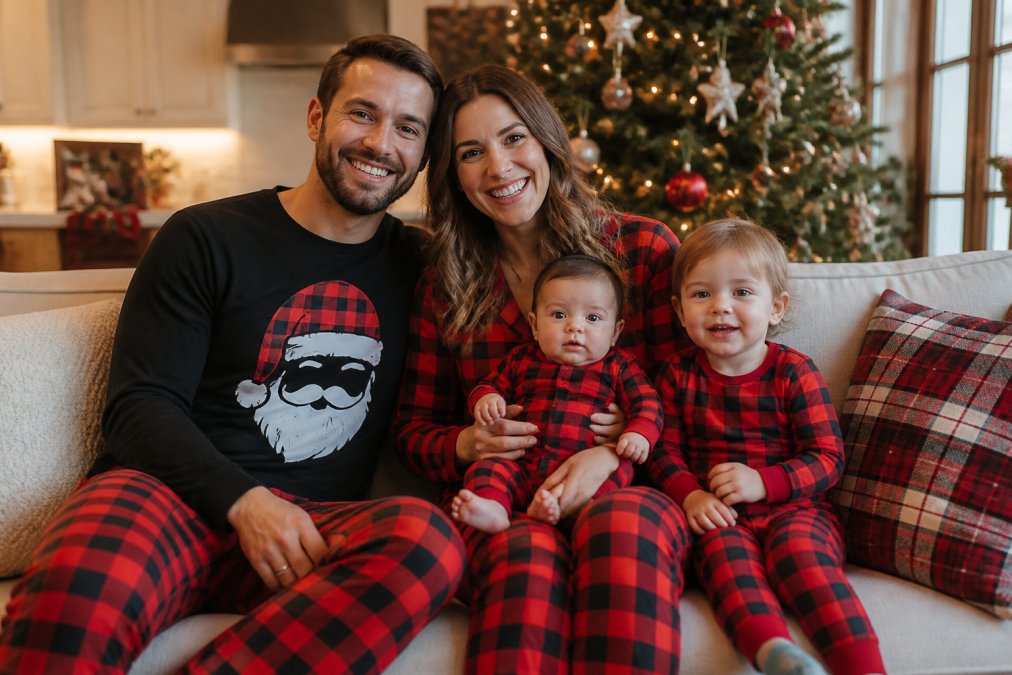
Coordinating Without Looking Like a Costume
The "costume" problem happens when every family member wears the exact same print, garment, and color with no variation. It reads as a uniform, not a family.
The fix is deliberate variation within a shared palette:
- One family member wears the print; others wear solids from the same color family
- Mix fabric weights: a chunky knit on one person, a smooth jersey on another
- Vary silhouettes: a hoodie, a set top, and a onesie all from the same palette look cohesive but not identical
- Let accessories carry the accent color on adults while kids wear it in the main piece
The Coordinates Christmas Yo-Yo-Yo Set (Kids) ($39) works well in this framework: kids wear the graphic tee as the statement piece, and parents anchor in a coordinating solid.

Styling for Different Age Groups and Body Types
Let each person wear the silhouette that suits them, and let the color palette do the coordinating work.
For infants, onesies and footie pajamas are the natural choice. The Christmas Bold Plaid Onesie (Kids) ($49) from Coordinates keeps babies comfortable while pulling the same plaid pattern that ties into the broader family palette.

For adults, body type inclusivity matters. Tops that skim rather than cling, mid-rise bottoms, and layering pieces like open cardigans or hoodies give everyone flexibility to wear what feels good.
Pro Tip
When shopping matching family outfits that span newborn to adult sizes, confirm the brand carries true extended sizing, not just "up to XL." Coordinates offers [men's, women's, kids, and baby sizes](/collections/womens), which makes it easier to dress the whole family from a single collection without mismatched palettes across different stores.
Tips for Choosing Family Photo Outfits That Photograph Well
Not every outfit that looks good in person photographs well. Camera lenses and lighting conditions affect how colors and patterns render. According to photography guidance from the Professional Photographers of America, solid colors and subtle patterns consistently outperform busy prints in portrait photography because they keep the viewer's eye on faces rather than fabric.
Pattern Mixing and Texture Coordination
Pattern mixing is one of the most effective tools in family outfit planning. The rule is not "no patterns," it's "no two competing patterns at the same scale."
A large plaid paired with a small geometric works because the scale contrast prevents visual clutter. The practical approach:
- Choose one dominant pattern (usually worn by the kids)
- Pull one color from that pattern for the solid pieces worn by others
- Add texture variation through fabric choice: a waffle-knit, a smooth jersey, and a brushed fleece all photograph differently and add depth to a group shot
Texture coordination is underrated. Mixing a matte fabric with a slightly shiny one, or a knit with a woven, creates visual interest that reads as intentional styling.
Accessorizing for a Cohesive Look
Accessories are the easiest way to tie a family's outfits together when the main pieces don't share an exact color.
Practical accessory strategies for family photos:
- Footwear: Match everyone's shoe tone (all warm neutrals, all white, all dark) even if the styles differ
- Hair accessories: Bows, headbands, or clips in the accent color pull children's outfits into the palette
- Layering pieces: A matching cardigan or vest in a neutral shade unifies the group
- Jewelry and watches: Keep adult accessories minimal and in the same metal tone
Watch Out
Avoid mixing warm and cool metal tones in accessories across a family group. Gold and silver together pull the eye in different directions and undermine the cohesive look.
How to Style Matching Family Outfits for Every Season
Seasonal styling for matching family outfits follows a simple logic: dress for the light, not just the weather.
Winter and Holiday Season: Warm reds, deep greens, cream, and plaid photograph beautifully under the warm, low light of December. The Christmas Snowflake Set (Kids) ($39) from Coordinates fits this palette precisely.
Fall: Earthy tones, rust, mustard, olive, and camel, work with the golden-hour light that makes outdoor fall portraits appealing. Layering adds texture and warmth.
Spring: Soft pastels and fresh whites photograph cleanly in the bright, even light of spring.
Summer: Crisp whites, navy, and bright accent colors work well. Linen and lightweight cotton photograph better than synthetic blends.
Key Takeaway
The season determines your palette range, but the light determines whether those colors photograph well. Plan your outfit palette around your expected shoot time as much as the calendar date.
Building a Capsule Wardrobe for Matching Family Outfits
A capsule wardrobe approach to matching family outfits is more practical than it sounds. Invest in a small set of versatile, high-quality pieces that mix and match across multiple occasions rather than buying single-use sets for every event.
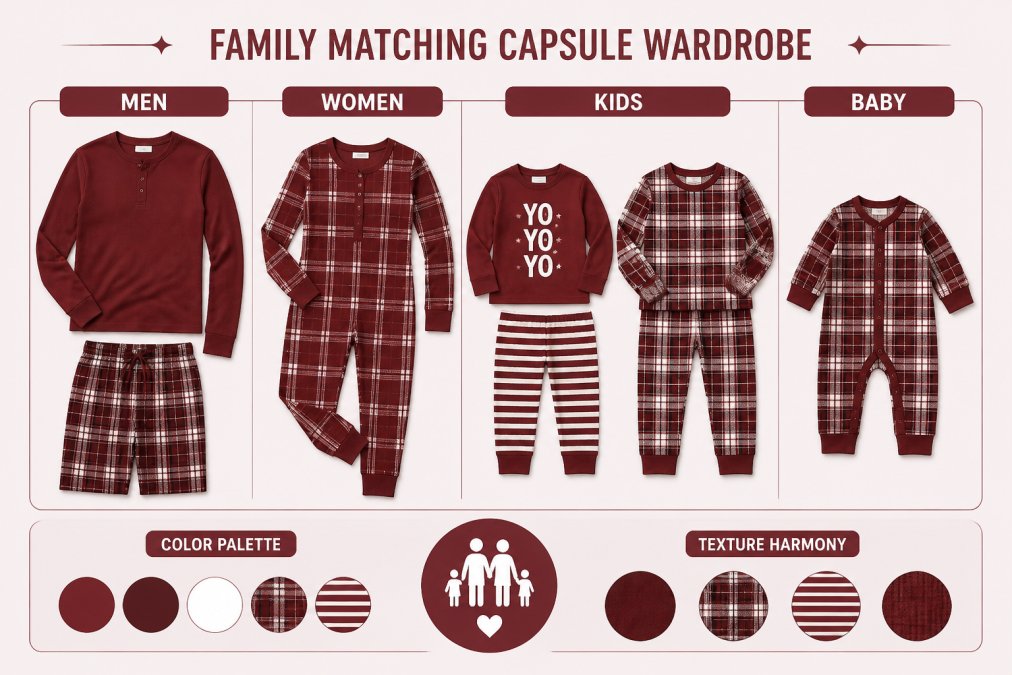
Wardrobe Staples That Mix, Match, and Last
Core pieces to prioritize:
- Solid-color tops in your anchor neutrals (cream, white, navy, grey) for every family member
- One or two seasonal print pieces that introduce the accent color
- Layering pieces (cardigans, hoodies, vests) in neutral tones
- Solid-color bottoms that complement both the anchor neutrals and the accent colors
Quality matters. Pieces that hold their color after repeated washing, maintain their shape, and feel comfortable against children's skin get worn repeatedly. As the Sustainable Apparel Coalition's guidance on textile longevity notes, extending the active life of a garment is one of the most effective ways to reduce the environmental footprint of a wardrobe.
Inclusive Sizing and Non-Traditional Family Configurations
Matching family outfits require flexibility for non-traditional family configurations. The color palette framework handles this naturally. A grandparent in a cream sweater, a step-sibling in a navy top, and a toddler in a red plaid set all read as part of the same family portrait if they share the same three-color palette.
For families that include dogs, a dog bandana or vest in the accent color pulls a pet into the family photo. Coordinates offers men's, women's, kids, and baby sizing across its collections, which means the whole family can pull from the same palette without shopping multiple stores.
Styling matching family outfits gets complicated fast when you're trying to accommodate different ages, body types, and style preferences all at once. The color palette approach cuts through that complexity by giving every family member a shared visual language without requiring identical pieces. Coordinates offers holiday and seasonal collections designed with exactly this challenge in mind: pieces that coordinate across newborn to adult sizing, built from quality materials that hold up beyond a single photo session. Explore the full range and find your family's palette with the Coordinates SHOP COLLECTION.
Frequently Asked Questions
How do you coordinate matching family outfits without looking too matchy-matchy?
The trick is to coordinate, not clone. Pick a shared color palette of two or three colors and let each family member wear a different combination. One person wears the dominant color as a solid, another wears it as a pattern, and a third wears an accent. This creates visual harmony in photos without making everyone look like they're in a uniform. Mixing textures, like a plaid top paired with a solid bottom, adds depth and keeps the look feeling natural rather than staged.
What colors look best for family photos?
Earth tones, muted blues, soft greens, and warm neutrals photograph consistently well because they don't compete with skin tones or backgrounds. For holiday family portraits, deep reds, forest greens, and navy create a festive, photo-ready aesthetic. Avoid neon colors or stark white, which can wash out faces or cause exposure issues. A simple rule: choose one anchor color everyone shares, then build complementary colors around it so the group reads as cohesive without being identical.
Should family members wear the same patterns or different ones?
Different patterns work better than identical ones, as long as they share a color story. Pair a bold plaid on one family member with a smaller-scale print or solid on another. The key is scale contrast, mix a large pattern with a small one rather than two competing prints of similar size. This approach keeps matching family outfits feeling intentional and styled rather than like everyone grabbed the same item off the same rack.
How do you style matching family outfits for different seasons?
Adapt the palette and fabric to the season. For fall and winter, lean into warm tones, plaids, and layering with heavier fabrics like fleece or flannel. For spring and summer, lighter fabrics in pastels or bright complementary colors work well. Holiday loungewear sets, like coordinated Christmas plaid or snowflake prints, are a go-to for winter family portraits and Christmas morning photos. The same coordination principles apply year-round; only the color temperature and fabric weight shift.
This article was written using GrandRanker


