

Posted by Editorial Team
on November 15, 2026

Quick Summary
Look for crisp edges, even ink coverage, colors that match the design, and multi-color lines that register cleanly with no gaps. Feel also helps: screen printing sits on top of the fabric, so it often feels slightly thicker than softer DTG prints.
- Check letter edges and fine lines for sharpness and absence of bleeding.
- Look for flat, smooth ink with no thin or patchy areas.
- Confirm multi-color designs line up with no gaps or overlaps.
- Screen-printed ink often feels slightly thicker than DTG ink.
- Wash a physical sample five times to test durability before bulk ordering.
Want matching sets that hold up?Coordinates designs family and team loungewear built for comfort and lasting prints.
Shop Matching Family Loungewear
Table of Contents
- Why Print Quality Matters More Than Most Shoppers Expect
- Visual Signs of a High-Quality Screen Print
- How to Tell If a Shirt Is Screen-Printed or DTG
- DTG vs Screen Printing: Which Holds Up Better
- Red Flags That Signal a Poor-Quality Print
- How to Tell If a T-Shirt Is High Quality Beyond the Print
- How to Spot High-Quality Screen Printing on Apparel Online Before You Buy
- Booking Your Next Matching Set With Confidence at Coordinates
- Frequently Asked Questions
Why Print Quality Matters More Than Most Shoppers Expect
Last Updated: November 14, 2026
Most shoppers judge a shirt by its color and fit, then blame the printing when the graphic cracks after three washes. Screen printing on apparel is one of the most durable decoration methods available, but only when it is done well. This guide shows you how to check screen print quality yourself before you buy.
A good print lasts. A poor one peels, fades, or looks blurry from the start. Knowing the difference saves money and keeps matching family sets looking sharp through the holidays.
- Print quality affects how long the shirt stays wearable
- Crisp graphics make team and family pieces look intentional
- Poor prints often show their flaws within the first few washes
Visual Signs of a High-Quality Screen Print
Start with your eyes. A well-made screen print has sharp edges, even ink coverage, and colors that match the design file. Look closely at the lettering and fine lines. They should be clean, not fuzzy or broken.
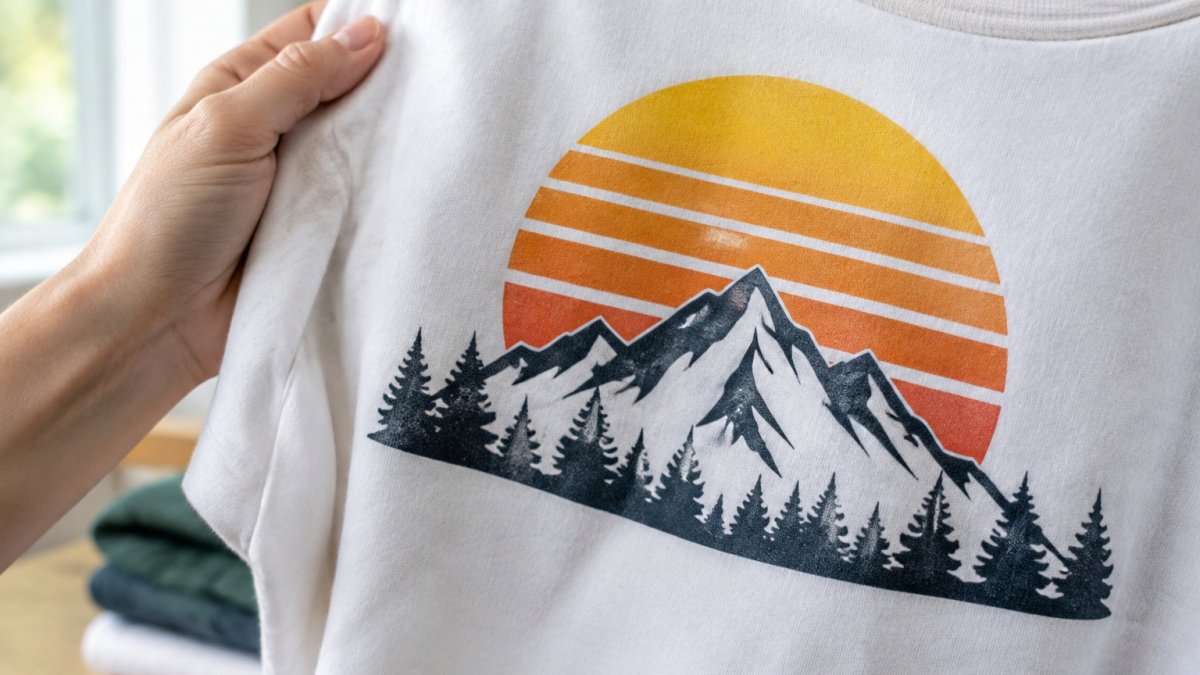
!Close-up of a hand holding a cotton tee under soft daylight, with the printed chest graphic in sharp focus
Check these details in the store or on the product photos:
- Edges: Letters and outlines look crisp, with no bleeding into the fabric
- Color: Shades look bold and consistent across the whole design
- Coverage: Ink lies flat and smooth, with no thin or patchy areas
- Registration: Multi-color designs line up with no gaps or overlaps
How to Tell If a Shirt Is Screen-Printed or DTG
Screen printing and direct-to-garment (DTG) printing look similar in photos. Feel is the fastest way to tell them apart. Screen-printed ink sits on top of the fabric and often feels slightly thicker. DTG ink soaks into the cotton and feels softer, almost like the shirt itself.
DTG vs Screen Printing: Which Holds Up Better
Screen printing usually holds up better over many washes, especially on bold, solid designs. The ink is thicker and cures firmly into the fabric. DTG works well for detailed, full-color artwork and small runs, but it can fade faster on dark shirts over time.
Neither method is automatically better. The right choice depends on the design and how often the garment will be worn and washed.
| Feature | Screen Printing | DTG Printing |
|---|---|---|
| Durability over many washes | Strong for solid designs | Good, may fade on dark fabric |
| Best for | Bold graphics, large runs | Detailed artwork, small runs |
| Feel | Thicker ink layer | Soft, blends into fabric |
| Color range | Limited per screen | Full-color photo detail |
Red Flags That Signal a Poor-Quality Print
Most print failures are not random. They trace back to a small set of production defects, and each one has a recognizable look and a known cause. Learning to name the defect helps you tell a genuine production problem from normal fabric texture, and helps you describe the issue clearly if you need to raise it with a seller.
Misregistration. On a multi-color design, the screens are printed one at a time and must line up precisely. When they do not, you see a sliver of the shirt color between two colors, a halo of one color peeking out from behind another, or outlines that shift from one side of the graphic to the other. A common pattern is a design that looks aligned at the center but drifts at the edges, which usually means the screens were not registered to the same platen position.
Pinholes. These are tiny unprinted dots where ink failed to release from the screen mesh. They are most visible in large solid areas and on dark garments, where the shirt color shows through as bright specks. A few isolated pinholes can be normal on a heavily textured fabric; a cluster across a solid block is a defect.
Uneven ink coverage. Also called a thin or starved print, this shows as blotchy areas where the ink looks lighter, grainy, or translucent. It often appears near the edges of a large graphic or where the squeegee pressure was inconsistent. Hold the shirt at an angle to a light source, uneven coverage reveals itself as a patchy sheen rather than a smooth, uniform surface.
Fibrillation. On ringspun cotton and cotton blends, tiny fibers can poke up through the ink film, giving a solid print a fuzzy, speckled, or washed-out appearance. It is distinct from fading: the color is still there, but the surface looks hairy under raking light. Fibrillation is more common on dark shirts and on prints without an underbase.
Bleeding and haloing. Ink that spreads past the intended edge produces fuzzy lettering or a colored halo around the graphic. This is often caused by too much ink, insufficient flash time between colors, or a mesh count that is too coarse for the detail in the artwork.
Off-center or tilted placement. Placement errors are easy to miss on a folded shirt. Lay the garment flat and measure from each shoulder seam to the nearest edge of the print. A difference of more than roughly a quarter inch is usually visible to the eye and worth flagging.
Watch out: normal fabric texture, the visible weave of a cotton tee or the looped surface of a fleece, is not a defect. Judge the print by whether the ink film itself is continuous, aligned, and fully cured, not by whether the fabric underneath is perfectly smooth.
If you spot two or more true defects on a new garment, treat it as a signal that the print is likely to fail early, and ask about the printer's cure and registration process before ordering more.
How to Tell If a T-Shirt Is High Quality Beyond the Print
A great print on a weak shirt still disappoints.
Note the collar, too. It should spring back after you stretch it gently. A collar that stays bent or loose usually signals low-grade construction.
How to Spot High-Quality Screen Printing on Apparel Online Before You Buy
You cannot touch a shirt through a screen, so the goal online is to gather the same evidence you would collect in person: edge sharpness, coverage, registration, ink feel, and durability. Treat product photos and reviews as a substitute for a store visit, and read them in a fixed order so you do not miss anything.
1. Inspect the photos at full zoom. Open each image at its largest size and look at the boundary between ink and fabric. Crisp edges hold a clean line; poor edges look fuzzy, stepped, or haloed. Check a multi-color area for registration, colors should meet without a gap of shirt color between them. Look for pinholes in large solid blocks and for blotchy, lighter patches that suggest uneven coverage. If the only photo is a small flat-lay shot, that is itself a limitation: you cannot judge edge quality from a thumbnail.
2. Read reviews for durability language, not star ratings. Search the review text for words like cracked, peeled, faded, washed, and shrunk. A single complaint is noise; a pattern of the same complaint across several reviewers is a signal. Pay attention to reviews that mention how many washes the shirt survived, and discount reviews written before the garment was ever washed.
3. Ask for a physical sample before a bulk order. For any order beyond a few pieces, request a sample or a pre-production proof printed on the same garment color and fabric you plan to order. A proof on white cotton tells you little about how the same design will behave on a dark heather or a polyester blend. Approve the sample against the checklist below, and keep it as the reference for the full run.
4. Run a wash test on the sample. Wash the sample inside out in cold water on a normal cycle, then tumble dry low, the same way the garment will be laundered in real use. Repeat for at least five cycles, checking after each one. You are looking for four failure modes: cracking along fold lines, fading or dulling of color, peeling or lifting at the edges, and color transfer onto the inside of the shirt or onto other laundry. A print that still looks and feels close to new after five cycles is a strong indicator of proper curing and ink selection.
5. Confirm color under neutral light. Judge color in daylight or under a neutral-white bulb, not under warm store lighting or a phone screen at full brightness. Online product photos are frequently color-corrected, so treat the photo as a guide to hue and contrast rather than an exact match. If color accuracy is critical, for team colors or a brand palette, ask the printer for a physical color proof or a Pantone reference before the run.
6. Ask the printer the questions that reveal process. A few direct questions separate a careful shop from a casual one: What ink system do you use, and is it plastisol, water-based, or discharge? Do you print an underbase on dark garments? How do you cure, and do you verify cure temperature? What is your registration tolerance on multi-color jobs? Can you print a sample on my exact garment? Clear, specific answers are a better quality signal than any marketing claim.
Use this checklist before you order:
- Close-up photos show crisp edges and no haloing
- Multi-color areas show no gaps or overlaps between colors
- Large solid areas show no pinholes or patchy coverage
- Reviews mention wash durability, not just fit and color
- A physical sample is available on the exact garment you plan to order
- The sample survives five wash-and-dry cycles without cracking, fading, peeling, or transfer
- Color is confirmed under neutral light or with a physical proof
- The printer can explain ink type, underbase, and cure process
Booking Your Next Matching Set With Confidence at Coordinates
Matching family pieces should look good and last. When you check print quality, fabric weight, and construction, you know what you are getting before the holiday arrives. Coordinates offers a curated selection of family loungewear. Explore the matching loungewear collection to find pieces that fit your family's style.
For a closer look at how fabric affects comfort and durability, read our guide to cotton blends for team clothing. If you are weighing a university-branded purchase, see how our apparel quality compares with a university co-op. When you are ready to see a finished print up close, browse The Black Santa Top.

Frequently Asked Questions
How to tell if a shirt is screen-printed or DTG?
Look closely at the print surface. If the product listing doesn't state the method, ask the seller directly before you buy.
Are screen-printed shirts good quality?
They can be, and screen printing is widely used for durable apparel because thick plastisol ink layers hold up well to repeated washing when properly cured. Quality depends on the ink, the number of passes, the curing temperature, and the garment itself. A well-executed screen print with crisp edges and even coverage should stay vibrant after many washes. Poor execution, such as under-cured ink or thin coverage, leads to cracking and peeling.
Does screen printing last longer than DTG printing?
In most cases, screen printing lasts longer, especially on bold graphics with solid color areas. Its thicker ink film resists fading and cracking through repeated wash cycles. DTG prints feel softer and handle fine detail well, but they can fade over time, particularly on dark garments if the pretreatment or curing was not done carefully. Your results also depend on care: wash inside out, use cold water, and avoid high heat in the dryer.


