

Posted by Editorial Team
on October 02, 2026

Table of Contents
- What to Look for in Holiday Family Outfits
- How to Style Matching Family Outfits Without Looking Cheesy
- Quick Comparison: Fabrics for Holiday Family Outfits
- Cotton and Spandex Blends: The Comfort Standard
- Flannel and Brushed Cotton for Cold-Weather Gatherings
- Fabric Weight and Layering: Dressing for Indoor Heat and Outdoor Cold
- Best Matching Family Pajamas for Holidays: What to Buy
- Caring for Holiday Fabrics So They Last More Than One Season
- Frequently Asked Questions
Last Updated: October 2, 2026
What to Look for in Holiday Family Outfits
The best fabrics for holiday family outfits are cotton-spandex blends, brushed flannel, and merino wool, because they balance breathability, stretch, and warmth for every age in the family. This guide from Coordinates breaks down which fabrics work for babies, kids, and adults, and how to pick pieces everyone will actually wear past December. According to the American Academy of Pediatrics' guidance on dressing children, breathable natural fibers help regulate body temperature and reduce skin irritation, which matters when little ones are running hot at a crowded family gathering.
Why Fabric Choice Matters More Than Color
Color gets all the attention in family photos, but fabric decides whether anyone smiles through them. A scratchy synthetic blend turns a toddler into a meltdown by dessert.
The right fabric also survives gravy spills, dog cuddles, and a dozen washes before New Year's, determining whether holiday family outfits return next season or head to the donation bin.
How to Style Matching Family Outfits Without Looking Cheesy
The trick to styling matching family outfits is coordinating a shared color palette and texture rather than wearing identical prints head to toe. Pick one anchor fabric, like a red-and-green plaid, then let each person wear a different silhouette in that palette. Mom in a plaid onesie, Dad in a plaid hoodie, kids in plaid sets, and the dog in a matching hoodie reads as intentional rather than costumed.
A few styling rules that keep it classy:
- Choose two or three colors and repeat them across every outfit
- Mix silhouettes so nobody looks like a photocopy
- Add one neutral, like cream or oatmeal, to break up the pattern
- Let one family member wear a solid in the same palette for contrast
To test the waters, start with pajamas rather than daytime outfits, they feel playful by default, so coordination reads as fun instead of forced.
Quick Comparison: Fabrics for Holiday Family Outfits
| Fabric | Warmth | Breathability | Best For | Care Level |
|---|---|---|---|---|
| Cotton-spandex blend | Medium | High | Babies, kids, all-day wear | Easy, machine wash |
| Brushed flannel | High | Medium | Cold-weather gatherings | Moderate, wash cold |
| Merino wool | High | High | Adults, layering | Delicate, hand wash |
| Velvet | Medium | Low | Photos and formal events | Dry clean preferred |
| Satin | Low | Low | Sophisticated evening looks | Delicate, hand wash |
| Bouclé and knits | Medium | Medium | Textured statement pieces | Gentle cycle |
Cotton and Spandex Blends: The Comfort Standard
Cotton-spandex blends are the best all-around choice for holiday family outfits: they stretch with movement, breathe well, and hold up to repeated washing. A 95% cotton, 5% spandex mix gives softness plus enough give for crawling babies and growing kids.
Why 95% Cotton and 5% Spandex Works for Every Age
The cotton keeps the fabric breathable when a house full of relatives runs warm, while the spandex adds recovery so knees and elbows don't bag out after a week of wear, and the blend resists the pilling that plagues cheaper synthetic knits.
For families who want one fabric that works from newborn to grandparent, this is it. Coordinates builds its Legacy Plaid collection around exactly this blend: the Legacy Plaid Sweatshirt ($59.00) uses a 95% cotton, 5% spandex terry, and the matching Christmas Legacy Plaid Onesie for women ($79.00) uses the same blend in a full-zip silhouette with a hood and front pockets.

Pro Tip
Check the spandex percentage before you buy. Anything under 3% spandex tends to lose shape at the knees and elbows within a few wears, especially on active kids.
Flannel and Brushed Cotton for Cold-Weather Gatherings
Brushed cotton flannel is the warmest everyday option for cold-weather gatherings because of a mechanical process, not a fiber difference.
That warmth comes with a trade-off: flannel runs hot indoors, so it works best for outdoor photos, chilly car rides, or a drafty older house. In a warm climate or well-heated home, save flannel for outdoor moments and switch to a lighter cotton blend for dinner.
Flannel Weight: Why Not All Flannel Is Built for the Same Job
Flannel weight determines where it belongs in a holiday wardrobe:
- Lightweight (roughly 4-5 oz per square yard): works as a shirt or a layering piece indoors. Good for mild climates and heated homes.
- Midweight (roughly 5-7 oz): the classic flannel shirt weight. Warm enough for a cold photo session, breathable enough to survive a crowded living room for an hour or two.
- Heavyweight (7 oz and up): best for outdoor wear, cold-weather travel, and drafty venues. Too warm for most indoor gatherings.
If a product page doesn't list a weight, check the description: "brushed" or "double-brushed" flannel is usually midweight or heavier, while a "flannel shirt" without a weight is often lightweight.
Flannel vs. Brushed Cotton vs. Cotton Flannel
These terms get used interchangeably, but they aren't identical:
- Cotton flannel is woven cotton brushed on one or both sides, the standard for holiday shirts and pajama sets.
- Brushed cotton is a broader term that includes flannel but also covers brushed twills and other weaves, and is often slightly smoother.
- Flannelette is a lighter, looser flannel common in budget sleepwear; it pills faster and doesn't hold up to repeated washing.
For holiday family outfits, cotton flannel and brushed cotton are worth buying. Flannelette rarely survives past one season.
The Lint Problem (and How to Fix It)
Brushed cotton sheds lint for the first few washes, and that lint transfers to anything it touches in the laundry. A few rules:
- Wash new flannel pieces separately for the first two or three cycles.
- Turn garments inside out to reduce abrasion and pilling.
- Wash cold on a gentle cycle; hot water accelerates pilling and shrinkage.
- Tumble dry low or lay flat; high heat shrinks cotton and roughens the nap.
- Skip fabric softener, which flattens the nap that makes flannel warm.
Pro Tip
If you're buying flannel for a family photo session, wash and dry the pieces once before the shoot. New flannel can look stiff and slightly shiny in photos, and one wash softens the nap so it drapes naturally.
Who Flannel Works Best For
Flannel is strongest for adults and older kids who spend time outdoors, anyone in a cold climate, and families gathering in a drafty older home. It's weaker for babies and toddlers who run hot, warm indoor parties, and mild-winter regions where it becomes a one-wear purchase, there, a cotton-spandex blend or lighter knit does the same job without the heat.
Fabric Weight and Layering: Dressing for Indoor Heat and Outdoor Cold
Layering solves the biggest holiday dressing problem: the same day often includes a cold outdoor photo session and a warm indoor dinner. The answer is a three-layer system, each layer doing a different job, so family members can add or remove pieces as the day shifts.
Legacy Plaid Swaetshirt (Unisex) →
The Three-Layer System, Explained
- Base layer: sits against the skin. Its job is moisture management and breathability. Cotton-spandex blends and merino wool both work here. Avoid synthetic base layers for kids, since they trap heat and can irritate sensitive skin.
- Mid layer: provides insulation. Brushed flannel, fleece, and midweight knits are the standard choices. This is the layer you remove first when you step indoors.
- Outer layer: provides style, wind resistance, and the photo-ready finish. Velvet, bouclé, heavier knits, and structured wool coats live here.
The key insight most guides skip: the mid layer is the one that comes off. If your mid layer is a heavy flannel shirt, your base layer must look presentable on its own once the flannel is gone, which is why cotton-spandex blends, holding shape and color through a full day, are the practical base layer for holiday family outfits.
Matching Layer Count to Age and Activity
Babies and young children need one less layer than adults, because they heat up quickly and can't easily regulate their own temperature. A common pattern:
- Babies and toddlers: base layer plus one light mid layer indoors; outer layer only for outdoor time.
- Young kids (roughly 4-10): base plus mid layer indoors; outer layer for outdoor photos.
- Teens and adults: base, mid, and outer as needed; adults who run cold may want a heavier mid layer.
- Older adults: often need one more layer, since circulation and temperature regulation change with age.
Watch Out
Overdressing babies for indoor gatherings is a common mistake. Overheating causes fussiness and skin irritation, and it's the fastest way to ruin a family photo session. Dress infants in breathable cotton and add layers only when you head outside.
A Practical Layering Formula for Holiday Family Outfits
Here's how the system translates into garments for a typical holiday day:
- Base layer: cotton-spandex blend tee, onesie, or long-sleeve top for everyone
- Mid layer: brushed flannel shirt, midweight knit, or fleece for kids and adults; skip for babies indoors
- Outer layer: velvet dress, bouclé cardigan, or structured wool coat for photos and outdoor time
Merino wool makes an excellent mid layer for adults, it regulates temperature and resists odor, though it needs gentler care. For kids, a midweight cotton knit is better: softer on sensitive skin and machine washable.
Transitioning Between Indoor and Outdoor Without a Meltdown
The hardest part of a holiday day isn't the cold, it's the switch. A few habits make it smoother:
- Keep a basket or bag near the door for outer layers, so they come off in one place.
- Have kids remove their mid layer as soon as they come inside, before they start running around.
- Bring a spare base layer for babies and toddlers in case of spills.
- For outdoor photos, put outer layers on last, right before you walk out the door.
Climate Adjustments
The same three-layer system works in every climate, you just change the weights:
- Cold climates: midweight or heavyweight mid layer, insulated outer layer, wool socks and hats outdoors.
- Mild climates: lightweight mid layer, unlined outer layer, and a base layer that stands alone indoors.
- Warm climates: skip the mid layer. Use a breathable base plus a lightweight outer layer for photos, then change into something cooler for the meal.
The goal is a small set of pieces, a breathable base, a removable mid, and a photo-ready outer, that mix and match across the whole family and the whole day.
Best Matching Family Pajamas for Holidays: What to Buy
The best matching family pajamas for holidays use a soft cotton-spandex blend in a festive print, with sizing from newborn to adult.
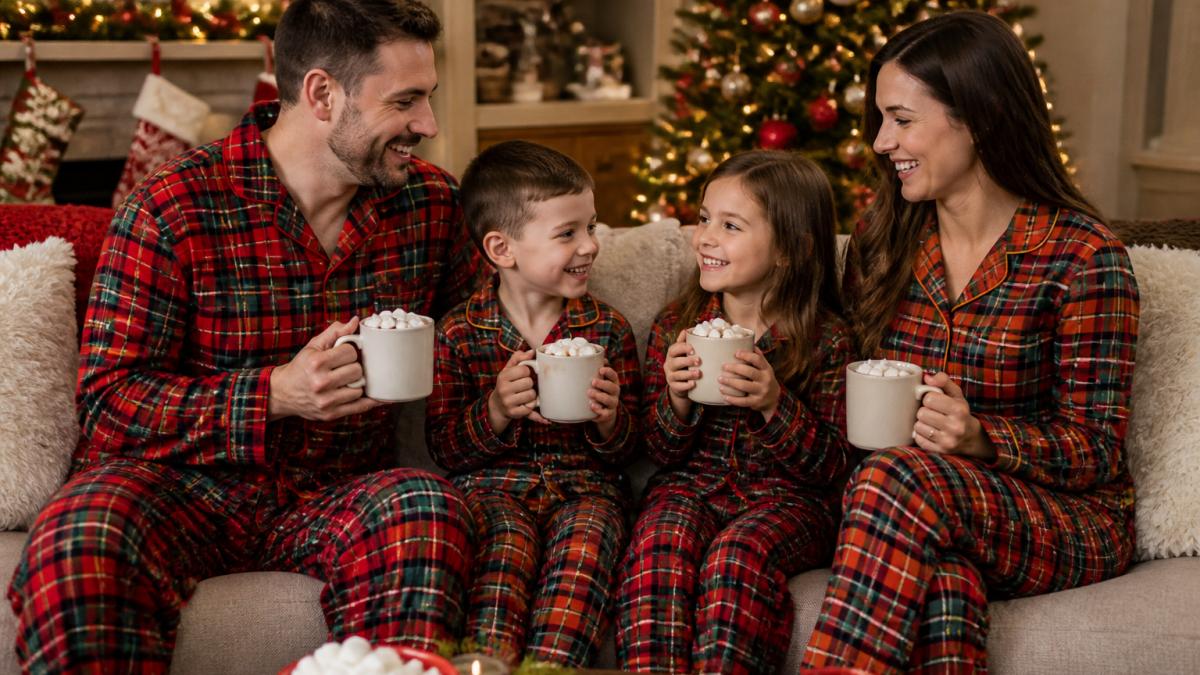
Coordinates carries the full range in its Legacy and Bold Plaid collections, from a baby onesie ($29.00) with a full zipper for easy diaper changes up to adult sizes. The kids' Legacy Plaid set ($39.00) pairs a long-sleeve crewneck top with jogger-style pants and an adjustable drawstring waist, so it fits through a growth spurt.


The Christmas Doggie Hoodie ($39.00) extends the set to pets, with a harness hole and sizes XS through XL. It's the detail most matching-pajama brands skip, and it's the one that makes the photo complete.
| Piece | Price | Sizes | Fabric |
|---|---|---|---|
| Baby onesie | $29.00 | Newborn-24 months | 95% cotton, 5% spandex |
| Kids' plaid set | $39.00 | Kids | 95% cotton, 5% spandex |
| Kids' onesie | $39.00 | NB-YXXL | 95% cotton, 5% spandex |
| Women's onesie | $79.00 | Adult | 95% cotton, 5% spandex |
| Doggie hoodie | $39.00 | XS-XL | 95% cotton, 5% spandex |
Caring for Holiday Fabrics So They Last More Than One Season
Holiday fabrics last multiple seasons when you wash cold, dry low, and store clean.
A simple care routine that works for most holiday loungewear:
- Turn garments inside out before washing to protect prints and embroidery
- Wash cold on a gentle cycle with like colors
- Skip fabric softener, which coats fibers and reduces breathability
- Tumble dry low or lay flat to dry
- Store folded, not hung, to prevent shoulder stretching in knits
- Treat velvet and satin separately, since both prefer hand washing or dry cleaning
This routine also matters for sustainability: well-cared-for cotton-spandex pieces hold shape and color for years, meaning fewer replacements and less waste, and a classic plaid outlasts a trend-driven print well beyond one holiday season.
Key Takeaway
The single best thing you can do for holiday fabric longevity is wash cold and dry low. It costs nothing and roughly doubles how long stretch blends keep their fit.
Picking fabrics for holiday family outfits comes down to one question: will everyone actually wear them past the photo?
Frequently Asked Questions
What are the most comfortable fabrics for matching family pajamas?
Cotton and spandex blends rank highest for comfort because they balance breathability with stretch. A 95% cotton, 5% spandex mix moves with the body, resists overheating, and stays soft after repeated washing. Flannel and brushed cotton work well for colder climates, while velvet and satin suit photos but feel less breathable for all-night wear. For families with young children, cotton blends reduce the risk of skin irritation and let kids move freely during play and sleep.
How do I choose durable fabrics for holiday family photos?
Look for tightly woven cotton blends, which hold their shape and color through multiple washes. Avoid fabrics that pill easily or lose structure after one wear. Cotton-spandex blends resist stretching out at the knees and elbows, which matters when kids are sitting, crawling, and climbing during a photo session. Check care labels: machine-washable fabrics that keep their print and fit after five or more cycles are the safest bet for annual holiday traditions.
Are natural or synthetic fabrics better for holiday gatherings?
Natural fibers like cotton and merino wool breathe better and feel softer against sensitive skin, making them ideal for long holiday gatherings where people move between warm indoor spaces and cooler outdoor areas. Synthetic fabrics can trap heat and cause sweating, especially for children. That said, a small percentage of spandex in a cotton blend adds stretch and shape retention without sacrificing breathability, which is why 95% cotton and 5% spandex is a common choice for family loungewear.
What fabrics are best for keeping the family warm during winter festivities?
Flannel, brushed cotton, and merino wool provide the most warmth without bulk. Flannel traps air between its brushed fibers, creating insulation, while merino wool regulates temperature and wicks moisture. For indoor celebrations where heating runs high, lighter cotton blends prevent overheating. Layering matters too: a cotton base layer under a flannel or knit outer layer lets family members adjust as they move between rooms or step outside for photos.



