

Posted by Editorial Team
on October 06, 2026

Table of Contents
- Why Accurate Measurements Matter for Family Loungewear
- What You'll Need Before You Start Measuring
- Matching Family Pajama Sizing Guide: Step-by-Step Measurement Instructions
- How to Measure Chest and Inseam for Clothing: A Quick Reference
- Tips for Buying Matching Family Outfits Online
- Measuring for Different Body Types and Ages
- Troubleshooting Common Fit Issues and Shrinkage
- Conclusion: Enjoy Comfort and Coordination
- Frequently Asked Questions
Last Updated: October 6, 2026
Why Accurate Measurements Matter for Family Loungewear
Getting the right fit starts with one number: the measurement you take before you order. Learning how to measure for matching family loungewear saves you returns and the disappointment of a set that fits one person and nobody else.
Fit accuracy matters more with family sets than single pieces: one wrong size throws off the whole photo, and since most families order several sizes at once, one measuring session up front beats guessing and reordering later.
Here is what we will cover: what you need, how to measure, and how to handle tricky body types.
Key Takeaway
Measure once, write it down, and keep those numbers in your phone. You will reuse them for every holiday set, every year, for every family member.
What You'll Need Before You Start Measuring
Gather your tools first so nobody stands still twice. The kit is short and cheap:
- A soft measurement tape, the kind used for sewing
- A piece of string and a ruler, if you do not have a tape
- A notebook or phone for writing numbers down
- Form-fitting clothes on the person being measured
- A flat wall for height checks
- The size chart for the set you plan to buy
A common mistake is measuring over bulky clothes. A thick sweatshirt can add inches to a chest measurement. Have everyone change into a fitted tee and leggings or shorts first.
Measure in the morning when you can; bodies change slightly through the day, and it keeps numbers consistent across family members.
Matching Family Pajama Sizing Guide: Step-by-Step Measurement Instructions
This matching family pajama sizing guide walks through each step in order. Work one person at a time and write down every number.
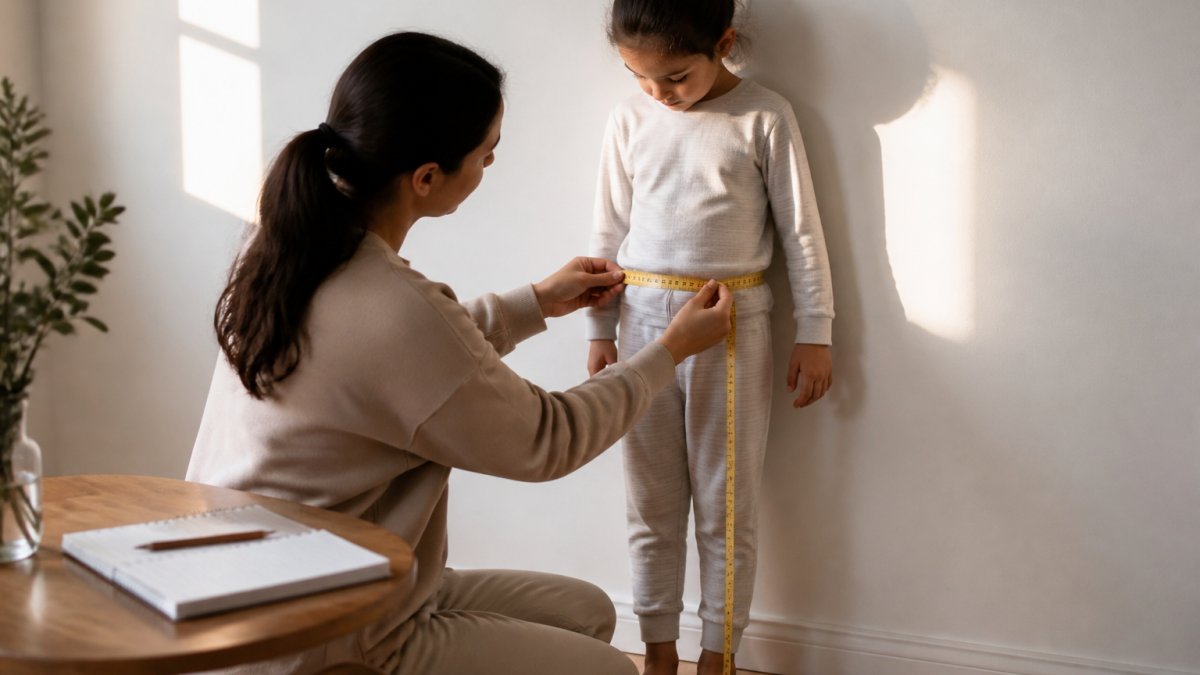
Step 1: Measure Body Circumference
Chest, waist, and hips are the three circumference numbers you need. Keep the tape level and snug, not tight.
- Chest circumference: Wrap the tape around the fullest part of the chest, under the arms. Keep it parallel to the floor.
- Waist: Find the natural waist, the narrowest point above the belly button. Do not pull in.
- Hips: Measure around the fullest part of the seat.
For kids, add a little room. A snug-fit number leaves no space to grow. The CDC growth charts are a useful reference for checking that a child's height and weight sit in a typical range before you pick a size.
Step 2: Measure Inseam and Garment Length
Inseam decides whether pants drag or ride up; garment length decides how a top or onesie sits.
To measure inseam, have the person stand straight. Run the tape from the crotch seam down the inside of the leg to the ankle bone. If measuring a wiggly toddler, measure a pair of pants that already fits and use that number instead.
For garment length, measure from the top of the shoulder down to where you want the hem to fall. Compare that to the flat-lay measurement in the size chart.
How to Measure Chest and Inseam for Clothing: A Quick Reference
Knowing how to measure chest and inseam for clothing comes down to two habits: keep the tape level and write the number down right away. Here is a quick reference to screenshot.
| Measurement | Where to Place the Tape | Watch Out For |
|---|---|---|
| Chest circumference | Fullest part of chest, under arms | Tape sagging in back |
| Waist | Natural waist, above belly button | Holding your breath |
| Hips | Fullest part of seat | Tape twisted or tilted |
| Inseam | Crotch seam to ankle bone | Measuring a bent leg |
| Garment length | Shoulder top to desired hem | Forgetting shrinkage allowance |
One insider tip: measure the person, then measure a favorite piece that already fits well. If the numbers disagree, trust the clothing, it is real-world proof.
Tips for Buying Matching Family Outfits Online
Buying matching family outfits online works best when you check three things before you click buy: the size chart, the fabric composition, and the return window. Skip one and you are gambling.
Size charts vary by brand, and a "medium" is not universal. Match your body measurements to the brand's own chart, not the size you wear elsewhere, the chart settles size up versus size down debates fast.
Fabric matters just as much.
Pro Tip
Order the kids' sizes last. Adults rarely change size between Thanksgiving and New Year, but children can grow a full size in that window. Buying kids' sets closer to the event means a better fit on the day.
A few more checks before checkout:
- Read the care label for wash instructions
- Confirm the size range covers everyone, from baby to adult
- Check shipping speed against your event date
- Look for adjustable waistbands on kids' pants
Measuring for Different Body Types and Ages
Standard sizing does not fit every body, so adjust by age and shape. A newborn, a tall teenager, and a plus-size adult each need different handling; below are the extra landmarks generic size charts leave out.
Babies and Toddlers
Newborn essentials run on weight and length, not chest size. Measure head to heel with the baby flat on a firm surface, and weigh on a baby scale if you have one. Most newborn sizing uses weight bands, so match weight first and length second.
For toddlers, measure waist and inseam while they stand. Toddler bellies are rounder than adult bellies, so measure the waist at the fullest point of the tummy, not the narrowest.
A full zipper on a onesie makes diaper changes far easier, which is why we build our kids' onesies with one.
Plus-Size Adults
Plus-size sizing needs three extra numbers beyond chest, waist, and hips: upper arm circumference, thigh circumference, and torso length.
Measure the upper arm at the fullest point with the arm relaxed at the side. Measure the thigh at the fullest point, standing with feet slightly apart. Torso length is shoulder to crotch, taken along the front of the body.
A common pattern is that a brand's plus-size chart stops at 3X while the same brand's straight-size chart runs to XXL with different grading.
Legacy Plaid Swaetshirt (Unisex) →
Tall Adults
Tall sizing is not just longer legs. You need four numbers: torso length (shoulder to crotch), sleeve length (shoulder bone to wrist bone, arm slightly bent), inseam, and rise (crotch to waistband).
If a tall size is not offered, size up in the torso and accept a looser fit through the chest, or look for a set with a longer hem and a drawstring waist.
Petite Adults
Petite sizing is about proportion, not just height. The two numbers that matter most are torso length and rise; a petite adult in a standard size often finds the waistband too low and shoulder seams dropping past the natural line.
Measure torso length and rise, then compare against the brand's petite chart if one exists. If it does not, look for a cropped or shorter-length top and a mid-rise or high-rise bottom, which together mimic petite proportions without a dedicated size run.
Matching Sets for Pets
Matching sets for pets come down to three numbers: neck girth, chest girth, and back length from the base of the neck to the base of the tail.
Measure neck girth at the widest point where a collar sits, chest girth just behind the front legs at the deepest point of the ribcage, and back length along the spine.
For a pet that plays outside, pick a durable fabric that can take a wash. A pet outfit is not a gimmick if it fits and holds up.
Troubleshooting Common Fit Issues and Shrinkage
Most fit problems trace back to four causes: a stretched tape, a skipped measurement, shrinkage, or a pattern that does not match your proportions. Fix the first two by re-measuring; fix the last two with the guidance below.
Planning for Shrinkage
Shrinkage allowance is the space you build into a purchase for fabric that may tighten after washing. The amount depends on the fiber:
- Cotton and cotton-rich blends: can shrink noticeably on the first hot wash and dry, then stabilize. Most practitioners plan for a small allowance on the first wash and none after.
- Cotton and spandex blends: shrink less because the spandex holds shape, but the cotton portion still moves. A cold wash and low dry keeps it minimal.
- Synthetic fleece and polyester blends: shrink very little, but can pill and lose loft with high heat.
- Wool and wool blends: can shrink dramatically with heat and agitation, never tumble dry.
Two habits keep shrinkage under control:
- Wash in cold water
- Tumble dry low, or hang to dry
If a garment feels tight after one wash, it may relax with wear; if it feels tight out of the bag, size up. A snug-fit top that never loosens is a return waiting to happen.
Fit Problems and How to Fix Them
Top rides up when you sit. This is a torso-length problem, not a size problem.
Pants drag or show ankle. This is an inseam mismatch. Measure your inseam and compare against the garment's stated inseam, not the size label.
Waistband gaps in back. This usually means the rise is too low for your body. Measure your rise and look for a higher-rise bottom.
Shoulder seams drop past the shoulder. This is a shoulder-width mismatch.
Sleeves too short. Measure sleeve length from the shoulder bone to the wrist bone with the arm slightly bent.
Watch Out
Never guess a child's size based on age alone. A four-year-old can wear anything from 3T to 5T depending on height and build. Measure every time, because last year's number is often already wrong.
When to Return vs. When to Keep
If the garment is within one size of fitting and the fabric is a cotton blend, wash cold and dry low once, it may relax into place. If it is more than one size off, or the fabric is a synthetic that will not move, return it. Check the return window before you wash, because most retailers will not accept a return on a washed garment.
Conclusion: Enjoy Comfort and Coordination
The best family photos start with numbers, not luck. Measure each person, match those numbers to the size chart, and plan for a little shrinkage. That method works for every holiday and season.
When you are ready to put it into practice, Coordinates makes it easy. Our collection runs from baby to adult, with pieces like the Legacy Plaid Sweatshirt in a soft cotton-spandex blend, the Christmas Legacy Plaid Onesie for kids with a full zipper for easy changes, and the Christmas Legacy Plaid Set with an adjustable drawstring waist.


Get started with Coordinates and turn your measurements into a set everyone will actually wear.
Frequently Asked Questions
How do I measure my child for loungewear sizing?
Measure your child's chest at the fullest point, waist at the natural waistline, and inseam from crotch to ankle. Use a soft measuring tape and keep it snug but not tight. For babies, measure length and weight, as many brands use these for sizing. Always check the specific size chart for the brand, as children's sizing varies. If between sizes, size up for growing room.
Should I size up when buying matching family pajamas?
It depends on the fabric and fit preference. Cotton and cotton-blend loungewear may shrink slightly after washing, so sizing up can help maintain fit. For children, sizing up allows for growth. However, if the pajamas are made with spandex for stretch, your usual size may be fine. Check the brand's shrinkage allowance and care instructions before deciding.
What are the most important measurements for a comfortable fit?
The key measurements are chest circumference, waist, hip, and inseam. For tops, chest and sleeve length matter most. For bottoms, waist and inseam are critical. Also consider garment length for tunics or dresses. Taking these measurements ensures a snug-fit without being restrictive, especially for sleepwear comfort. Always compare to the brand's size chart.
Do loungewear brands use standard sizing charts?
No, sizing varies by brand. Some use standard sizing (e.g., S, M, L), while others offer size-inclusive ranges with specific measurements. Always refer to the individual brand's size chart and measure yourself rather than assuming your usual size. For matching family loungewear, check if the brand provides a unified chart across age groups to ensure consistency.
Ready to find your family's fit? Explore the Coordinates collection and bring everyone together in comfort and style.



