

Posted by Editorial Team
on November 04, 2026

Last Updated: November 4, 2026
Quick Summary
Dress a large family on a budget by taking inventory of what you already own, then building each child a small capsule wardrobe of 14 to 18 mix-and-match pieces per season. Buy second-hand first, compare unit pricing on multipacks, and track every clothing dollar with a shared budgeting app.
- Sort all clothing into four piles: keep now, store for later, hand down, and donate.
- Pick two accent colors and one neutral per child so every top matches every bottom.
- Build each capsule in three passes: base, connectors, then gaps, buying second-hand first.
- Never buy ahead more than two sizes, since kids skip sizes and bins go unworn.
- Set a monthly cap per child before the season and log every purchase the same day.
Table of Contents
- Step 1: Take Inventory Before You Spend a Dollar
- Step 2: Build a Capsule Wardrobe for Children
- Step 3: Master the Best Thrift Store Shopping Tips for Families
- Step 4: Compare Unit Pricing Before You Bulk Buy
- Step 5: Set Up a Seasonal Clothing Rotation System
- Step 6: Find the Best Matching Family Outfits for Photos Without Overspending
- Step 7: Track Every Clothing Dollar With Budgeting Apps
- Build Your Family's Coordinated Wardrobe With Coordinates
- Frequently Asked Questions
Step 1: Take Inventory Before You Spend a Dollar
Learning how to dress a large family on a budget starts with knowing what you already own. Most parents buy before they count, then discover three duplicate winter coats and no pants that fit.
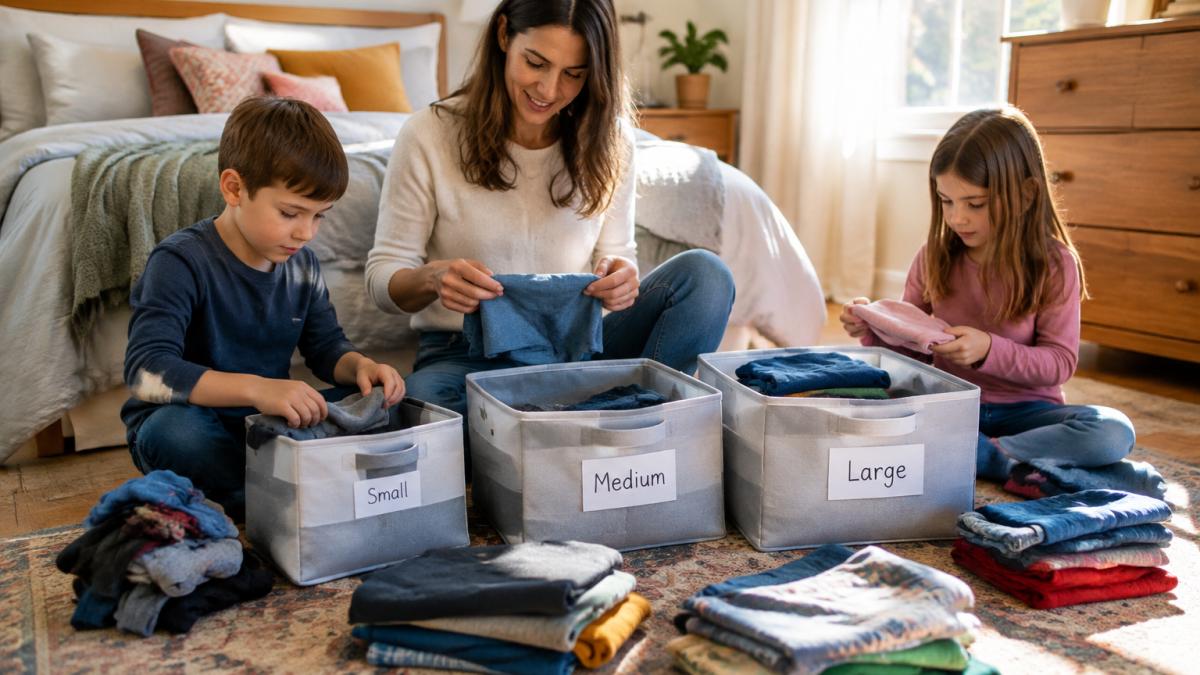
Sorting Hand-Me-Downs by Size and Season
Sort everything into four piles: keep now, store for later, hand down, and donate. Check each item for stains, missing buttons, and worn knees. A common mistake is storing clothes without labeling the size. Use a marker on every bin, or the next child will inherit a mystery bag.
Count what each child actually has:
- Everyday pants and shorts
- Long-sleeve and short-sleeve tops
- Socks and underwear
Write the totals down. That list becomes your shopping plan, and it stops you from buying a fifth pair of jeans nobody needs.
Step 2: Build a Capsule Wardrobe for Children
A capsule wardrobe for children is a small set of pieces that mix and match, so every top works with every bottom. Fewer pieces means fewer decisions, less laundry, and far less money spent.
How Many Pieces Does Each Child Actually Need?
Most kids get by with roughly 10 to 14 everyday pieces per season, plus sleepwear and one dressy outfit. A workable starting point:
- 4-5 bottoms (two pants, two shorts or skirts, one flexible neutral)
- 5-6 tops (three short-sleeve, two long-sleeve, one button-front or polo)
- 1-2 layering pieces (a hoodie and a cardigan or fleece)
That is 14 to 18 items total per child per season, which is far fewer than most closets hold. The number matters less than the rule behind it: every top must work with every bottom. If a piece only matches one outfit, it does not belong in the capsule.
The Two-Color-Plus-Neutral Rule
Pick two accent colors and one neutral per child, then buy only within that palette. A common pattern is navy or gray as the neutral, with one warm accent and one cool accent. Every top in the palette matches every bottom, so a child can dress without help and you can buy a single item without re-planning the closet.
This is also what makes hand-me-downs work across siblings. If that's you, our guide to matching family outfits for larger families shows how to plan sets that pass down cleanly from child to child.
Build the Capsule in Three Passes
Do not buy a capsule in one shopping trip. Build it in three passes so you spend only on real gaps:
- Pass one, the base. Pull from inventory every neutral bottom and solid top that already fits. This is usually half the capsule and costs nothing.
- Pass two, the connectors. Add the two or three pieces that make the existing items interchangeable: a neutral pant, a layering piece, a second top in an accent color. Buy these second-hand first.
- Pass three, the gaps. Only after passes one and two, fill what is still missing. This is the smallest and cheapest pass, and it is where most families overspend because they start here.
What a Capsule Saves, in Practice
A capsule cuts cost in three ways: fewer pieces bought, fewer pieces replaced mid-season, and more pieces handed down because they still match the next child's palette. It also cuts laundry, since a smaller drawer means clothes get washed and worn instead of buried. The trade-off is real: a capsule means more frequent washing of fewer items, so buy fabric that holds up. Watch out: a capsule built from thin, pilled fabric will wear out before the season ends and cost more than the larger wardrobe it replaced.
Keep the Capsule Honest
Once a season, lay the capsule out on the bed and pull anything that no longer fits or no longer matches the palette. Move fitting pieces to the next child's bin and move the rest to resale or donation. A capsule only saves money if it stays small; the moment it grows past the piece count, it becomes a regular closet again.
Here is the piece count a capsule wardrobe for children comes down to, per child per season.
| Item | Pieces | Note |
|---|---|---|
| Bottoms | 4-5 | Two pants, two shorts or skirts, one neutral |
| Tops | 5-6 | Three short-sleeve, two long-sleeve, one button-front or polo |
| Layering pieces | 1-2 | A hoodie and a cardigan or fleece |
| Coat and light jacket | 1 each | One warm coat, one light jacket |
| Sleep sets | 2-3 | Sleepwear kept outside the everyday count |
| Dressy outfit | 1 | For events and photos |
| Total per season | 14-18 | Everyday pieces run roughly 10 to 14 |
Step 3: Master the Best Thrift Store Shopping Tips for Families
The best thrift store shopping tips for families come down to timing and a list. Shop midweek, when stores are often quieter. Bring your inventory list and buy only what's on it.
Check these before you pay:
- Zippers and buttons work
- No thin or pilled fabric
- Soles still have tread
Watch out: never buy ahead more than two sizes. Kids skip sizes, and a stocked bin of clothes that never fit is money sitting in a closet. Budget-focused parents hunting sleepwear should read our tips on affordable family matching sleepwear sets before the next sale.
Step 4: Compare Unit Pricing Before You Bulk Buy
Bulk purchasing only saves money when the unit price is lower. Compare cost per item, not the total on the tag. A five-pack at one price can cost more per piece than singles on sale.
Do the math on the shelf:
Legacy Plaid Swaetshirt (Unisex) →
- Divide the pack price by the number of pieces
- Compare that number to the single-item price
- Check the size range, since kids grow out of multipacks fast
Stocking up on socks and underwear in the right size is smart. Stocking up on trend pieces is not. The same logic applies to grocery runs, utility bills, and every recurring cost in your household budget.
Step 5: Set Up a Seasonal Clothing Rotation System
A seasonal clothing rotation system keeps only the current season in drawers. Store everything else in labeled bins by size and season. Twice a year, swap the bins and check what fits.
This system does three things:
- It shows you gaps before you shop
- It protects clothes from wear and dust
- It makes hand-me-downs easy to pass along
When a bin comes out, pull the pieces that no longer fit. Our step-by-step guide on how to resell gently used matching family sets walks through photos, pricing, and listing so you can recoup part of what you spent.
Step 6: Find the Best Matching Family Outfits for Photos Without Overspending
The best matching family outfits for photos don't require a big spend. Pick one anchor piece, then build around colors you already own. Coordinate tones instead of buying identical sets for everyone.
A simple photo plan:
- Choose two or three colors
- Put the boldest piece on one person
- Keep everyone else in solids from the same palette
- Add one shared detail, like plaid or a matching trim
Our Legacy Plaid Swaetshirt (Unisex) at $59.00 works as that anchor, with festive MOM, DAD, GRANDMA, and GRANDPA embroidery in a warm cream tone. Pair it with the Christmas Legacy Plaid Set (Kids) at $39.00 for a coordinated look that photographs well without matching head to toe. Small extras stretch a look further, and our list of accessories that elevate family photo outfits covers the cheap wins.


Step 7: Track Every Clothing Dollar With Budgeting Apps
Budgeting apps turn clothing from a guess into a number. Set a monthly cap per child, log every purchase, and review the total at month's end. Expense tracking is the difference between a plan and a hope.
Pick the Right Kind of Tool
There are three practical categories, and most families need one from each:
- A shared household budget app. Look for one that supports multiple users on one account, envelope or category budgeting, and a per-child category. Common choices include apps built around zero-based budgeting and apps built around shared envelopes; the right pick is the one both adults will actually open.
- A receipt and purchase log. A simple shared spreadsheet or a note app works, as long as every clothing purchase lands in it the same day. The tool matters less than the habit of logging at the register.
- A resale tracker. A second sheet or tab for outgrown items sold, so resale income offsets the clothing line instead of disappearing into general spending.
Set the Caps Before the Season, Not During It
Set a monthly cap per child at the start of each season, based on the inventory list from Step 1 and the capsule gaps from Step 2. A workable structure is one cap for everyday clothing, one for shoes and coats, one for sleepwear and photo outfits, and a separate line for resale income. Review the caps twice a season, not weekly, so a single growth spurt does not blow up the plan.
What to Track
- Everyday clothing, by child
- Shoes and coats, which are the largest single items
- Sleepwear and photo outfits, which are easy to overspend on
Make the System Survive a Busy Week
The failure mode is a system only one adult uses. Readers cutting fast fashion from their spending will find our guide to alternatives to fast fashion family matching outfits useful for keeping costs and waste down.
Watch out: a budgeting app that is not shared will hide duplicate purchases, and two adults buying the same size of socks is one of the most common ways a large family overspends without noticing.
Build Your Family's Coordinated Wardrobe With Coordinates
Dressing a big family well takes a system, not a bigger paycheck. Count what you own, build small capsules, buy second-hand first, and rotate by season.
At Coordinates, we make the coordinated part easy. The Christmas Legacy Plaid Onesie (Kids) at $39.00 has a full zipper for easy diaper changes and is made from a soft 95% cotton, 5% spandex blend.

Get started with Coordinates and dress your whole family in comfortable, coordinated pieces you'll reach for all season.
Frequently Asked Questions
What is the most cost-effective way to buy clothes for a large family?
Combine three habits: buy secondhand first, shop end-of-season sales for the next size up, and pass clothing down between children instead of buying new for each kid. A capsule wardrobe for children keeps the number of pieces low, so each item gets worn more often. Add unit-price checks on multipacks and you cut the grocery-style impulse buys that add up fast.
How do you organize a clothing hand-me-down system?
Label storage bins by size and season, not by child. When an older kid outgrows something, it goes straight into the correct bin rather than a general pile. Keep a small mending kit nearby so torn seams and missing buttons get fixed before storage. Once a season, pull the next size bin and take inventory before buying anything new. This rotation keeps you from rebuying items you already own and makes back-to-school season far less expensive.
How can you maintain a cohesive look for family photos on a budget?
Pick a two- or three-color palette and let each person wear a variation of it rather than an identical outfit. Solid loungewear sets in coordinating tones photograph well and can be worn again after the shoot. Shop end-of-season sales or secondhand for the pieces you are missing, and reuse what each family member already owns.
How often should you replace children's clothing to stay within budget?
Replace items when they no longer fit or show real wear at the knees, cuffs, or seams, not on a fixed schedule. A capsule wardrobe for children of roughly 10 to 14 pieces per season means fewer items wear out at once. Check fit at the start of each season and mend small damage immediately, since repairs cost far less than replacements. Passing items down between siblings stretches each purchase across several years of use.
Ready to plan your family's next set of photos or holiday morning? Start with one anchor piece and build from there. Browse the Coordinates collection and find sizes for everyone under one roof.


