

Posted by Editorial Team
on September 05, 2026

Table of Contents
- Why Matching Outfits Get Harder as Your Family Grows
- Start With Family Photo Outfit Color Schemes, Not Exact Matches
- The Sizing Reality Check: What Actually Fits Bigger Kids and Adults
- Where to Find Plus Size Family Matching Outfits That Last
- How to Coordinate Coordinating Family Photo Outfits Without the Stress
- Practical Tips for Dressing Six or More People
- Conclusion: Build a Matching Capsule Your Family Will Actually Wear
- Frequently Asked Questions
Last Updated: September 6, 2026
Why Matching Outfits Get Harder as Your Family Grows
Dressing six or more people in matching family outfits for larger families is a logistics puzzle that most style guides simply ignore. The math gets complicated: you need coordinated clothing that spans newborn sizes up to adult 3XL, fits different body types, and still looks intentional in a group photo. Most parents abandon the idea entirely after one failed attempt with mismatched shades or an outfit that arrived too small for the oldest child.
The real problem isn't a lack of cute options. It's that standard advice assumes a family of four with similar proportions. Larger families need a different strategy, one built around color formulas, realistic sizing, and pieces that work beyond a single photo session. At Coordinates, we design matching family outfits with this reality in mind, which is why our range runs from baby to adult sizes.
The good news: you don't need identical outfits to get that pulled-together look. In fact, the most polished family photos rarely feature everyone in the exact same garment.
Start With Family Photo Outfit Color Schemes, Not Exact Matches
The secret to effortless-looking group photos is coordination, not duplication. Family photo outfit color schemes built around a shared palette create visual cohesion while letting each person wear what actually fits and flatters them. This approach solves the sizing problem before it starts.
A Foolproof 3-Color Palette Formula
Choose one dominant neutral, one accent color, and one pattern that ties them together. For example: cream as the base, forest green as the accent, and a plaid that combines both for one or two members. Everyone selects pieces within those three parameters, and the result reads as intentional without requiring identical garments.
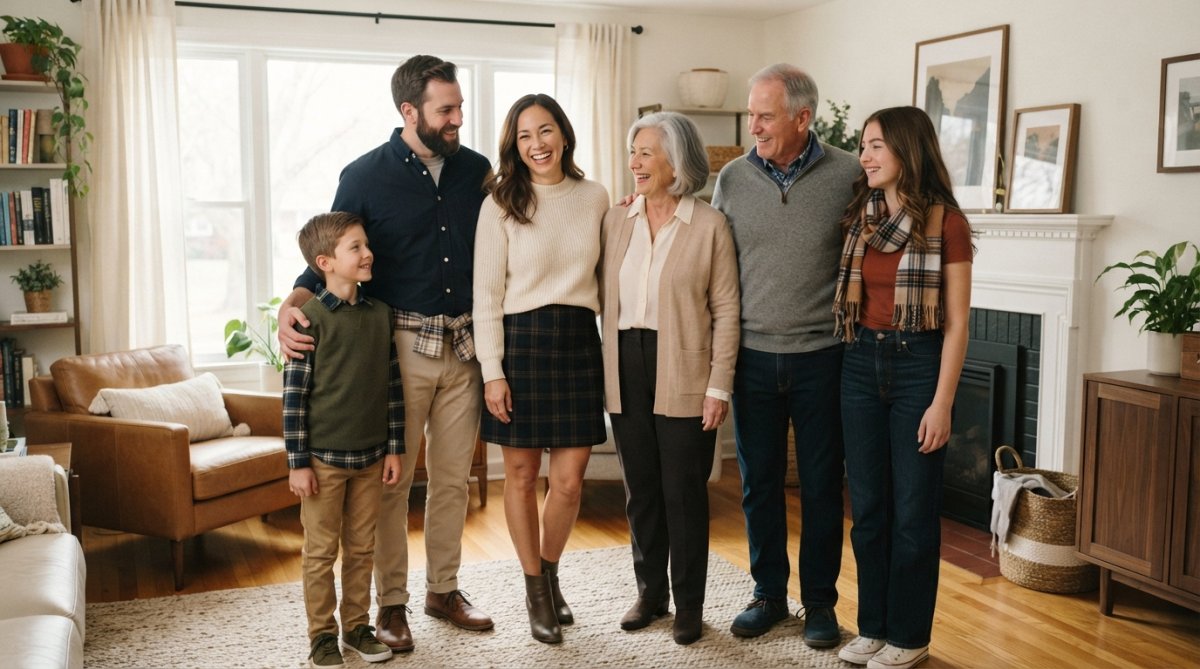
This formula works because it respects individual fit needs. A teenager who hates matching can wear solid cream; the youngest child gets the plaid onesie; Dad wears the green sweater. The palette does the coordinating work.

The Sizing Reality Check: What Actually Fits Bigger Kids and Adults
Here is where most matching family outfit plans fall apart. Standard family sets often top out at a kids' size 14 or an adult medium, leaving bigger kids and plus-size adults with no options. Before you fall in love with a particular look, verify the size range actually covers everyone on your list.
Look for retailers that publish detailed size charts with chest, waist, and hip measurements rather than vague S-M-L labels. For plus size family matching outfits, you need garments cut for real bodies, not just scaled-up versions of slim fits. Unisex sizing can be particularly tricky; a unisex large fits differently than a women's large, so measure the person who will wear it, not your memory of their usual size.
Watch Out
The most common mistake is ordering the same size for everyone who "wears a large." Unisex, women's, and kids' cuts all differ significantly. Check each garment's specific size chart against actual measurements, especially for bigger kids and plus-size adults.
Where to Find Plus Size Family Matching Outfits That Last
Finding plus-size family matching outfits isn't just about locating a retailer with a larger size range; it's about understanding how sizing translates across different brands and garment cuts. The market is fragmented, and a '2XL' from one brand can fit like a '1XL' from another. To avoid the frustration of receiving outfits that don't fit, you need a strategy for navigating this landscape.
The Brand-Mixing Strategy for Consistent Sizing
A common pattern among parents of larger families is to abandon the search for a single, complete set and instead build a coordinated look from different brands. This approach gives you more control over fit, but it requires a system. The key is to anchor your choices to a specific brand's size chart that you know fits your family members well, then use that as a reference point.
- Identify your 'anchor' brand: For each family member, find one brand whose size chart and fit you trust. This is your baseline.
- Measure, don't guess: Use a soft measuring tape to get the chest, waist, and hip measurements of each person. Write these down. This is your family's master size sheet.
- Cross-reference every chart: Before buying from a new brand, compare their size chart against your master sheet. Ignore the S-M-L-XL labels and focus on the actual inch or centimeter measurements.
- Look for 'curvy' or 'relaxed' fits: For adults, a standard 'unisex' cut is often boxy and tight in the shoulders. Look for brands that offer 'curvy' fits for women or 'athletic' or 'relaxed' fits for men, which provide more room where needed.
Decoding the Size Chart: What to Look For
Most size charts list chest, waist, and hip measurements, but they rarely tell you about sleeve length, shoulder width, or thigh circumference. For plus-size garments, these are often the first points of failure. A shirt might fit your chest but be too tight in the shoulders, or pants might fit your waist but be too snug in the thigh.
When a size chart is sparse, look for customer reviews that mention the fit on specific body types. Phrases like "runs small in the bust" or "true to size for a tall, plus-size man" are far more useful than a generic star rating. If a product has no reviews and a limited size chart, it's a risk that's rarely worth taking when you're buying for six or more people.
Fabric as a Sizing Equalizer
Fabric choice can also solve fit problems. A garment with 5% spandex or elastane will have more give and forgiveness than a 100% cotton version (peer-reviewed research). This is particularly important for plus-size garments, where a little stretch can mean the difference between a comfortable fit and a garment that pulls or rides up. When comparing options, prioritize fabrics that offer a balance of structure and stretch.
Watch Out
A common mistake is assuming that a 'plus-size' label guarantees a consistent fit across all garments from the same brand. A plus-size t-shirt and a plus-size hoodie from the same label will have different cuts and fits. Always check the specific garment's size chart, not just the brand's general sizing.
The Sustainable Capsule Approach for Plus-Size Families
Instead of buying a full matching set that might only be worn once, consider a capsule approach. This is a unique angle that most guides miss. The goal is to build a small collection of high-quality, mix-and-match pieces in a shared color palette that can be worn for multiple occasions. custom family gifts.
For example, for a fall photoshoot, you might choose a palette of rust, cream, and olive. Instead of buying a new plaid shirt for everyone, you could invest in a rust-colored cardigan for one parent, a cream button-down for the other, and olive-toned pants for the kids. These pieces can be mixed with other items in their existing wardrobes for months after the photoshoot. This approach is not only more budget-friendly, but it also reduces waste and avoids the 'single-use' feeling of many matching sets. It turns a one-time purchase into a long-term wardrobe investment.
This strategy also sidesteps the problem of finding a matching set that fits everyone. By focusing on a color palette rather than a specific pattern, you can choose garments from different brands that fit each person well, while still achieving a cohesive look.
How to Coordinate Coordinating Family Photo Outfits Without the Stress
Coordinating family photo outfits for six or more people requires a system, not guesswork. Start by designating one person as the decision-maker, then follow this sequence:
- Pick your 3-color palette before browsing anything
- Assign each family member a primary piece within that palette
- Confirm sizes against the retailer's chart for every person
- Order everything at once to avoid shade variations between batches
- Try everything on a week before the event, not the night before
Managing Different Style Preferences
Not everyone in a large family wants to match, and forcing the issue creates photo-day tension. Give reluctant members a solid-color option within the palette while enthusiastic members wear the pattern. The visual result still reads as coordinated, and you avoid the argument entirely. This approach works especially well for teenagers and partners who prefer subtlety over full matching sets.
Practical Tips for Dressing Six or More People
Beyond the color scheme, the logistics of large family dressing come down to preparation. A capsule approach to matching outfits means choosing versatile pieces that work beyond the single event, which stretches your budget further. But for families of six or more, the real challenge is managing the volume of clothing. Here is a practical system for handling the laundry, storage, and hand-me-down integration that comes with a large family wardrobe.
The Laundry Cycle: Protecting Your Investment
When you have six or more people, laundry is a constant. A single photoshoot outfit can easily get lost in the shuffle. To protect your investment, establish a 'special care' routine for your matching pieces.
- Wash all new items together before the first wear. This confirms no color bleeding and pre-shrinks the fabric. Use cold water and a gentle cycle (the FDA).
- Turn garments inside out before washing. This protects the outer surface from friction and fading.
- Air dry whenever possible. Dryers are the number one cause of shrinkage and fabric breakdown (the CDC). If you must use a dryer, use the lowest heat setting and remove items while they are still slightly damp.
- Designate a 'photo day' laundry bag. Have a dedicated mesh bag for all the matching pieces. This keeps them together and prevents them from being mixed in with the regular wash.
Storage Solutions for a Large Family Capsule
Storing matching outfits for a large family requires a system. You can't just throw everything in a shared closet and hope for the best. The goal is to have each person's outfit ready to go on the day of the event.
- Use a dedicated 'event bin'. After you've purchased and washed all the outfits, store them together in a single, labeled bin or hanging organizer. This prevents pieces from being worn for other occasions or getting lost in individual closets.
- Label everything. Use a permanent fabric marker to write each person's name on the care tag. This is essential for hand-me-downs and for preventing arguments on the morning of the photoshoot.
- Create a 'getting ready' station. The night before the event, hang each person's complete outfit on a single hanger, with accessories and shoes placed in a labeled bag underneath. This eliminates the morning scramble.
The Hand-Me-Down Pipeline: A Strategic Advantage
For families with multiple children, hand-me-downs are a fact of life. But they can be a strategic advantage when building a matching wardrobe. Instead of seeing hand-me-downs as a source of faded, mismatched clothing, you can use them to build a cohesive capsule over time.
- Invest in gender-neutral colors and patterns. When you buy matching outfits, choose palettes and patterns that will work for any child, regardless of age or gender. This maximizes the lifespan of each garment.
- Buy for the oldest, plan for the youngest. When you purchase a set, buy the oldest child's size first. As the youngest grows, they will inherit the pieces from the older siblings. This means you only need to buy new pieces for the oldest child each time.
- Establish a 'quality over quantity' rule. A well-made garment that survives three children is a better investment than three cheap outfits that fall apart after one wash. Prioritize durable fabrics and reinforced stitching.
- Create a 'mending' routine. A small tear or a loose button shouldn't end a garment's life. Keep a small sewing kit on hand and fix minor issues immediately to extend the life of your matching pieces.
Key Takeaway
The most effective way to manage a large family's matching wardrobe is to treat it as a system, not a one-time purchase. By establishing a laundry routine, a storage solution, and a hand-me-down pipeline, you can make your investment last for years and reduce the stress of coordinating outfits for every single event.
This logistical approach is what separates a one-time photoshoot outfit from a sustainable family wardrobe. It's not just about looking good in a single photo; it's about creating a system that makes dressing six or more people manageable, affordable, and even enjoyable.
Conclusion: Build a Matching Capsule Your Family Will Actually Wear
The key to successful matching family outfits for larger families is planning around real sizes and real preferences, not chasing perfect identical sets. Start with a flexible color palette, verify sizing for every family member, and invest in quality fabrics that survive repeated wear. This approach turns a stressful logistics problem into a repeatable system your family can use for every holiday and photoshoot.
Coordinates designs its family collections with this exact philosophy: wide size ranges from baby to adult, soft cotton-spandex fabrics built for comfort, and coordinated pieces that work together without requiring everyone to wear the same thing. From the Legacy Plaid Swaetshirt (Unisex) for adults to onesies for the youngest like the Christmas Legacy Plaid Onesie (Kids) and even matching dog hoodies like the Christmas Doggie Hoodie, the whole family can participate.

Frequently Asked Questions
Do family photo outfits need to match exactly or just coordinate?
Coordinating beats matching exactly, especially for larger families. When everyone wears the same exact outfit, differences in body types and skin tones become more obvious and the photo can look flat. Instead, pick a color palette of 3 to 4 complementary colors and let each person wear a different combination. For example, one child wears a cream top with plaid pants while another wears the plaid shirt with neutral bottoms. This creates visual cohesion without the stiffness of identical outfits.
How can I find coordinating plus-size family matching outfits?
Look for brands that list extended sizing across their entire matching collection, not just in separate plus-size sections. Coordinates offers matching sets from baby sizes through adult sizes. Check the size chart for each specific piece before ordering, since jogger-style pants and relaxed-fit hoodies tend to run more generously. When in doubt, size up for a comfortable fit that still photographs well.
What are the best color palettes for large family photos?
Neutral tones with one accent color work best for large families. Think cream, tan, olive, and soft denim with a single pop of rust or burgundy. These colors flatter a wide range of skin tones and keep the focus on faces rather than clothing. Avoid all-white or all-black outfits, which can look washed out or too harsh in photos. Plaid patterns in muted tones add texture and visual interest without overwhelming the frame.
How do I manage different style preferences in a large family?
Give each person one choice within a shared framework. Agree on a color palette first, then let individuals pick their preferred silhouette: joggers instead of jeans, a hoodie instead of a crewneck, or a onesie for the baby. This way, the family member who hates matching can wear a solid neutral piece while others wear the plaid. The outfits still read as coordinated because the colors work together, even if the styles differ.
Getting six or more people coordinated for a photo or holiday gathering takes strategy, not luck. Coordinates removes the guesswork with matching family outfits designed across the full size spectrum, from newborn to adult, in fabrics that hold up to real family life. Shop the collection today and see how simple coordinated family dressing can be.


