

Posted by Editorial Team
on September 09, 2026

Table of Contents
- Sizing Matching Family Pajamas: Start with the Right Mindset
- How to Measure for Family Pajamas: A Step-by-Step Guide
- The Matching Family Pajama Sizing Chart: Decoding the Numbers
- Finding Plus Size Matching Family Pajamas That Fit Well
- Fit-Testing for Different Body Types and Ages
- Should You Size Up in Pajamas? Fabric and Fit Considerations
- Common Sizing Mistakes to Avoid with Matching Pajamas
- Conclusion: Your Family's Perfect Fit Awaits
- Frequently Asked Questions
Last Updated: September 9, 2026
Sizing Matching Family Pajamas: Start with the Right Mindset
Finding the right way to size matching family pajamas often feels impossible when you're shopping for a newborn, a growing teenager, and two adults with completely different builds. The secret is to stop thinking in terms of "small, medium, large" and start thinking in terms of actual body measurements. This guide breaks down how to size matching family pajamas so every person in your household ends up with sleepwear that fits comfortably, looks great in photos, and survives the holiday season.
Most sizing guides fail because they assume every body is proportional. The reality is that a toddler's torso is proportionally longer than an adult's, and a teenager's growth spurt can make last month's measurements useless. By learning to measure properly and understanding how different fabrics fit, you can order with confidence for the whole crew. Below, we'll walk through the exact process we recommend, including the tools you need, the numbers that matter, and the common mistakes that lead to returns.
How to Measure for Family Pajamas: A Step-by-Step Guide
To size matching family pajamas correctly, you need three core measurements per person: chest circumference, waist, and inseam. These three numbers tell you more than any labeled size ever will, because sizing varies wildly between brands and even between different styles from the same retailer.
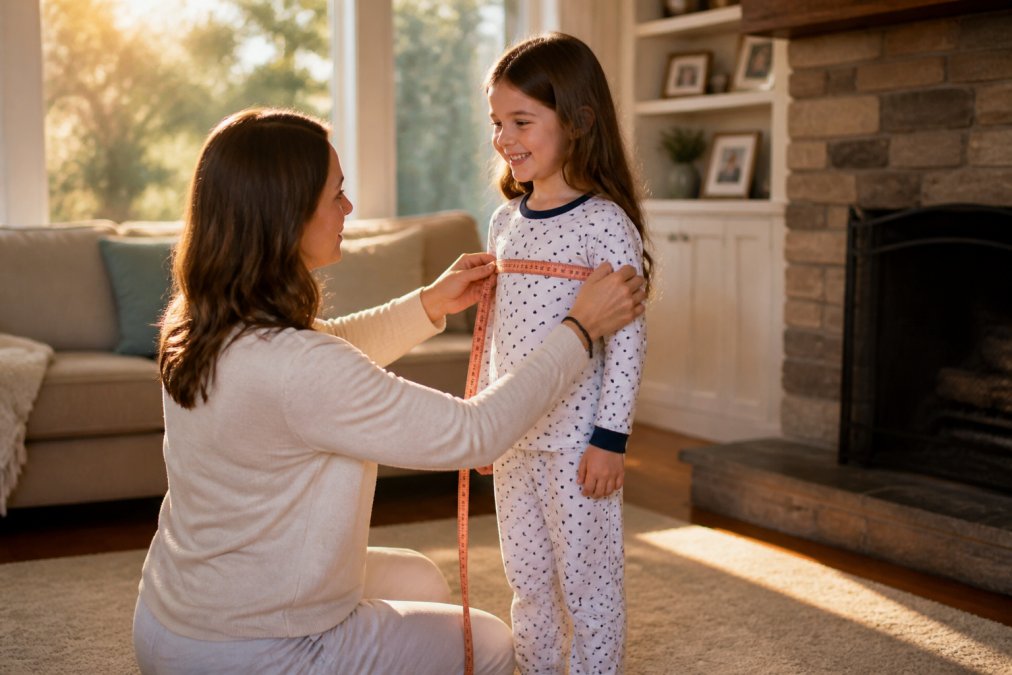
Here is the process we recommend for every family member, from babies to grandparents:
- Measure the chest: Wrap the tape around the fullest part of the chest, keeping it level under the arms. For babies and toddlers, do this over a diaper or thin onesie, not a bulky sleeper.
- Measure the waist: Find the natural waist, usually just above the belly button. For younger kids, the waistband should sit comfortably without digging in, so add a finger's width of slack.
- Measure the inseam: Run the tape from the crotch seam down to the ankle bone. This matters most for footed pajamas and for pants with cuffs.
- Measure the height: Have the person stand straight against a wall. Height is the single best predictor of fit for one-piece sleepers and footed options.
Tools You'll Need for Accurate Measurements
You do not need anything fancy to get reliable numbers. A soft, flexible fabric measuring tape is the essential tool, since the stiff metal tapes from the hardware drawer will not bend around a body. Keep a notebook or a notes app on your phone dedicated to family measurements, because bodies change fast, especially with kids. A growth chart on the wall helps for tracking height over time, and it makes the process feel like a fun ritual rather than a chore.
The Matching Family Pajama Sizing Chart: Decoding the Numbers
A reliable matching family pajama sizing chart translates raw measurements into a size label, but the translation is rarely one-to-one across brands. Most retailers publish a size chart that maps chest and height ranges to sizes like "2T" or "M," and your job is to find where your family's measurements land before you ever look at the label.
| Measurement | Baby (0-12 mo) | Toddler (2T-4T) | Kids (4-8) | Youth (10-14) | Adult S-XL |
|---|---|---|---|---|---|
| Chest | 16-18 in | 20-22 in | 23-26 in | 27-31 in | 34-46 in |
| Height | 26-30 in | 34-40 in | 41-52 in | 53-62 in | 62-74 in |
| Best fit for | One-piece sleepers | Two-piece sets | Snug-fit tops | Standard tees | Roomy lounge sets |
The most common source of frustration is assuming your child's clothing size matches their pajama size. Children's apparel sizes are often based on age, but pajama sizing leans on height and chest measurements because sleepwear should be snug, not baggy. Always defer to the numbers on the chart over the age printed on the tag.
Finding Plus Size Matching Family Pajamas That Fit Well
Plus size matching family pajamas require the same measuring discipline, but with extra attention to two areas: the chest and the upper arms. Many families report that adult sizing stops around a 2XL, which leaves bigger parents and teens without good options. A proper fit for plus size bodies means the top should follow the natural line of the shoulders without pulling across the back, and the pants should sit at the natural waist without requiring a drawstring to do all the work.
When you measure for plus size family members, take the chest measurement twice and use the larger number. Fabric behavior matters more here than anywhere else. A cotton-spandex blend gives where a rigid woven flannel will not, which is why stretch fabrics are often the practical choice for families with many body types. Look for sets that list the fabric blend openly, since a small percentage of spandex transforms how forgiving the fit feels.
Fit-Testing for Different Body Types and Ages
Sizing matching family pajamas across different body types comes down to one rule: fit for the largest part of the body, then adjust. A pear-shaped adult should order based on the hip measurement and expect to take in the waist, while someone with broad shoulders should size by the chest and accept a roomier torso. The goal is sleepwear that feels comfortable lying down, not just standing up, so have your family test the fit by reaching overhead and curling into a fetal position.
Sizing Tips for Babies and Toddlers
For babies and toddlers, prioritize safety and freedom of movement over a perfect fit. Sleepwear safety standards in the United States require snug-fitting garments to reduce fire risk, so avoid anything baggy for the youngest family members (cpsc.gov). Choose one-piece sleepers in the correct height range rather than sizing up for longevity, since excess fabric around the feet creates a tripping hazard for new walkers. Look for cuffs that can unfold to cover hands and feet, extending the usable life of the garment without compromising the safe fit.
Sizing Advice for Kids and Teens
Kids and teens are where growth spurts create the most sizing chaos. A child who wears a size 6 in jeans might need a size 8 in pajamas because their torso grew faster than their legs, or vice versa. Measure kids every season rather than assuming last year's size still works. For teens, involve them in the process and respect their preferences; a teenager who feels their pajamas are too childish will refuse to participate in the family photo, which defeats the whole purpose of matching sets.
Should You Size Up in Pajamas? Fabric and Fit Considerations
Whether you should size up in pajamas depends entirely on the fabric, not on a general rule. The hidden variable is shrinkage, and different fibers behave very differently in the wash. Here is the practical breakdown of what happens to the most common pajama fabrics after the first few laundry cycles.
Shrinkage by Fabric Type: What Actually Happens
100% Cotton (woven, like flannel or percale): This is the highest-shrinkage category. Most woven cottons are pre-shrunk at the mill, but pre-shrinking is not the same as shrink-proofing. A typical cotton flannel set can lose 3% to 5% of its length and width in the first hot-water wash and high-heat dryer cycle (peer-reviewed research). On a 40-inch inseam, that is a full 1.5 to 2 inches lost. If you buy 100% cotton true to size and wash it hot, the pants will ride up and the top will pull across the shoulders. Strategy: Size up one full size for 100% cotton, and wash in cold water with low heat for the first three cycles to minimize the initial shock.
Cotton Jersey (knit, like a classic t-shirt): Knit cotton stretches as it shrinks, which means it tends to lose more in length than in width. Expect 2% to 4% lengthwise shrinkage. The good news is that the knit structure recovers some of that stretch when worn. Strategy: Size up only if the set is described as "pre-shrunk", if not, size up one size for the length.
Cotton-Spandex or Cotton-Elastane Blends (typically 95% cotton / 5% spandex): The spandex acts as a recovery fiber. These blends shrink less than pure cotton, usually 1% to 2% at most, and they bounce back to shape when worn. Strategy: Buy true to size. Sizing up creates a sloppy, baggy fit that defeats the purpose of the stretch.
Bamboo Viscose (Rayon from Bamboo): Bamboo viscose is a manufactured fiber made from bamboo pulp. It has excellent drape and a silky feel, but it is prone to lengthwise shrinkage if dried on high heat. Expect 2% to 3% shrinkage in length, with minimal width change. Strategy: Buy true to size, and always hang dry bamboo sets. High heat can also weaken the fiber over time, causing pilling.
Polyester or Synthetic Blends (e.g., 100% polyester fleece): These are the most dimensionally stable. They shrink less than 1% under normal conditions. Strategy: Buy true to size. The bigger risk here is pilling and static, not shrinkage.
The Care Protocol That Preserves Fit
The single most effective way to control shrinkage is to control the dryer, not the washer. Cold water wash (below 80°F) minimizes fiber swelling, but the dryer's heat is what sets the shrinkage. Here is the protocol we recommend for any matching set you want to keep fitting for more than one season:
- Wash in cold water on a gentle or delicate cycle. Turn the pajamas inside out to protect the print.
- Never use high heat in the dryer. Use the "low" or "delicates" setting, and remove the garments while they are still slightly damp.
- Lay flat to finish drying for bamboo and cotton-spandex blends. This prevents the tumbling action from felting the fibers.
- For 100% cotton flannel, expect some initial shrinkage no matter what. Buy one size up if you plan to use a standard dryer.
The "Sizing Up" Trade-Off: Safety and Fit
Sizing up is not free. For children's sleepwear, the Consumer Product Safety Commission (CPSC) requires that sleepwear for sizes 9 months to 14 years be either snug-fitting or flame-resistant. A baggy, oversized set that is not flame-resistant fails the snug-fit requirement. This is not a style preference, it is a federal safety standard (16 CFR Part 1615 and 1616). If you size up for a child, you are creating a garment that is both a fire hazard and a tripping hazard for new walkers.
For adults, sizing up is a comfort trade-off. A roomier fit is more comfortable for lounging but can bunch up under a blanket and twist during sleep. The best approach for adults is to size up only in the specific dimension that needs room (e.g., a tall inseam or a broader chest) rather than buying a full size up across the board.
The Bottom Line
| Fabric | Expected Shrinkage (1st wash) | Sizing Strategy |
|---|---|---|
| 100% Cotton (woven) | 3-5% | Size up one full size |
| Cotton Jersey (knit) | 2-4% lengthwise | Size up if not pre-shrunk |
| Cotton-Spandex Blend | 1-2% | True to size |
| Bamboo Viscose | 2-3% lengthwise | True to size, hang dry |
| Polyester Fleece | <1% | True to size |
When in doubt, buy one set first, wash it according to the care label, and measure it again before ordering the rest of the family's sets. This "test wash" method costs you one set but saves you from returning five.
Common Sizing Mistakes to Avoid with Matching Pajamas
Mixing sizing strategies, such as ordering one child true to size and another child one size up, can create an inconsistent look in photos, which may defeat the purpose of matching sets. Pick one approach for the whole family: either everyone sizes according to their measurements, or everyone sizes up for a roomier, longer-lasting fit.
Another frequent error is ignoring the difference between "fitted" and "loose" styles. A snug-fit pajama top and a relaxed lounge top from the same brand can carry the same size label while fitting completely differently. Read the product description to understand the intended silhouette before you order. Finally, do not forget to measure the dog if you are including a pet in the matching set. Pet sizing is notoriously inconsistent, and a dog between sizes will be more comfortable in the larger option.
The Growth-Spurt Budgeting Strategy: Buy for the Season, Not the Year
The most expensive mistake families make is buying matching pajamas in a size that "they will grow into." This strategy can lead to discomfort and may not align with CPSC snug-fit safety standards for children's sleepwear. Additionally, by the time the child grows into the set, the holiday pattern may be out of season, and the fabric might have been sitting in a drawer for months.
A better strategy is to buy for the current season and plan for one growth spurt, not two. Here is a framework we recommend:
- Measure at the start of the season. In early November, measure each child's height and chest. Compare those numbers to the brand's size chart.
- Buy the size that fits now, not the size that fits in March. A child grows an average of 2 to 2.5 inches per year, but that growth is not linear (the CDC). Most growth spurts happen between ages 2-3, 4-5, and during the pre-teen years (10-12 for girls, 12-14 for boys). If your child is in the middle of a known growth-spurt window, size up one size. If they are between spurts, buy true to size.
- Use the "one-season" rule. If you are buying for a holiday event, the pajamas need to fit for that event and possibly one or two more wears. Do not buy for next year. The pattern will be dated, and the child's proportions will have shifted (a child's torso grows faster than their legs during certain phases).
- For fast-growing kids, buy separates if the brand offers them. Matching sets that allow you to buy the top and bottom separately let you replace only the piece that no longer fits. This is the most budget-friendly approach for families with multiple children.
The "Hand-Me-Down" Trap
Families with multiple children often try to save money by buying one size up so the set can be passed down. This approach may not be effective for pajamas because the fabric can wear out faster than daywear due to frequent washing. Additionally, the elastic in the waistband may degrade over time. Strategy: Consider buying each child their own correctly sized set, and look for brands that offer a multi-pack discount or a family bundle. The per-set cost is often lower than buying individual sets, and you avoid the fit compromise.
The "Photo-Ready" Fit Check
Before the holiday morning photo, do a 30-second fit check on every family member. Have them sit down, raise their arms overhead, and then curl into a fetal position on the couch. If the pants stay up without a drawstring, the top does not ride up to the midriff, and the cuffs stay at the wrists and ankles, the fit is correct. If any of those fail, swap the size before the photo, not after.
The Bottom Line on Mistakes
The goal is not a perfect fit on day one, it is a fit that survives the holiday season and the first few washes. Measure everyone, pick one sizing strategy for the whole family, and buy for the current season. That approach saves you money, keeps everyone safe, and ensures the matching set looks intentional in every photo.
Conclusion: Your Family's Perfect Fit Awaits
Getting the sizing right for matching family pajamas takes twenty minutes of measuring and a little patience with fabric care, but the payoff is a holiday morning where everyone is comfortable, cozy, and ready for the photo. At Coordinates, we design our loungewear collections with the whole family in mind, offering sizes that range from baby to adult so no one gets left out of the tradition. Our holiday sets, including the [Christmas Soft Plaid Set(/products/christmas-soft-plaid-set-kids) for kids | shopcoordinates.com], are crafted from breathable cotton blends that hold up wash after wash. Get started with Coordinates and find the perfect fit for every member of your family this season.
Frequently Asked Questions
Should you size up or down in matching family pajamas?
For most fabrics, size up if you are between sizes or prefer a looser, more comfortable fit for lounging. This is especially helpful for growing children, as it extends the life of the pajamas. However, pay attention to the fabric content. For snug-fit sleepwear made from materials like cotton, a more exact fit is safer and more comfortable. Always check the specific size chart for the brand, like our Coordinates chart, as fits can vary.
How do you ensure matching pajamas fit toddlers and adults equally well?
The secret is to use accurate body measurements rather than relying on age labels. Measure the chest, waist, and height for each family member, from your toddler to the adults. Then, consult a family pajama sizing chart that lists these measurements for each size. This approach helps you coordinate sizes across different body types, ensuring everyone gets a comfortable fit, even if a toddler needs a size 4T and a parent needs a size XL.
Are there specific sizing considerations for plus size matching family pajamas?
Yes, look for brands that offer extended sizing and provide detailed measurements for plus sizes. Pay close attention to the chest and hip measurements, not just the waist size, to ensure a comfortable fit. Also, check the fabric; a fabric with some stretch offers more give and comfort. Always measure yourself against the brand's size chart, as plus size ranges can differ between retailers.
How do I measure my family for matching sleepwear if I don't have a fabric tape measure?
You can use a piece of string or a non-stretchy ribbon. Wrap it around the body part you are measuring, such as the chest or waist. Mark the point where the string meets with your finger or a pen. Then, lay the string flat against a rigid ruler or a yardstick to get the measurement in inches. This method provides a reliable measurement for consulting a pajama sizing chart.


