

Posted by Editorial Team
on November 27, 2026

Last Updated: November 26, 2026
Quick Summary
Before buying clothes online, compare your own body measurements to the garment measurements in the size chart, not your usual size label. Then check fabric composition, stitching and seams, real customer photos and reviews, and the return policy including who pays return shipping.
- Measure chest, waist, hips and inseam over light clothing and write the numbers down.
- Garment measurements minus your body measurements equal ease, which most size charts leave out.
- A fitted tee needs 2 to 4 inches of ease at the chest; a coat needs 8 to 10 inches or more.
- A knit with 5% spandex forgives a tighter measurement than woven cotton with no stretch.
- Confirm the return window, who pays return shipping, and whether exchanges are free before ordering.
Ready to match the whole family?Coordinates makes cozy family loungewear, including official University of Texas gear, in sizes for everyone.
Shop Family Loungewear
Table of Contents
- Start With Your Measurements, Not the Size Label
- How to Buy Clothes Online That Fit: Match Measurements to the Size Chart
- How to Tell If Clothes Are Good Quality Online: Fabric, Stitching, and Seams
- Kids Clothing Fabric Safety and Durability: What Parents Should Verify
- How to Shop Online for the First Time: Reviews, Photos, and Seller Trust
- Returns, Shipping, and Consumer Protections to Confirm Before Checkout
- Your Pre-Checkout Checklist for Buying Clothes Online
- Frequently Asked Questions
Start With Your Measurements, Not the Size Label
Most shoppers start with the size label. That is the first mistake. A size label is a guess a brand makes about you, and no two brands guess the same way.
This guide covers the checks that save you from a bad fit, scratchy fabric, and a return you pay for yourself.
The short version: body measurements are the only reliable starting point. Size charts and reviews are cross-checks against them.
How to Measure Yourself and Your Kids at Home
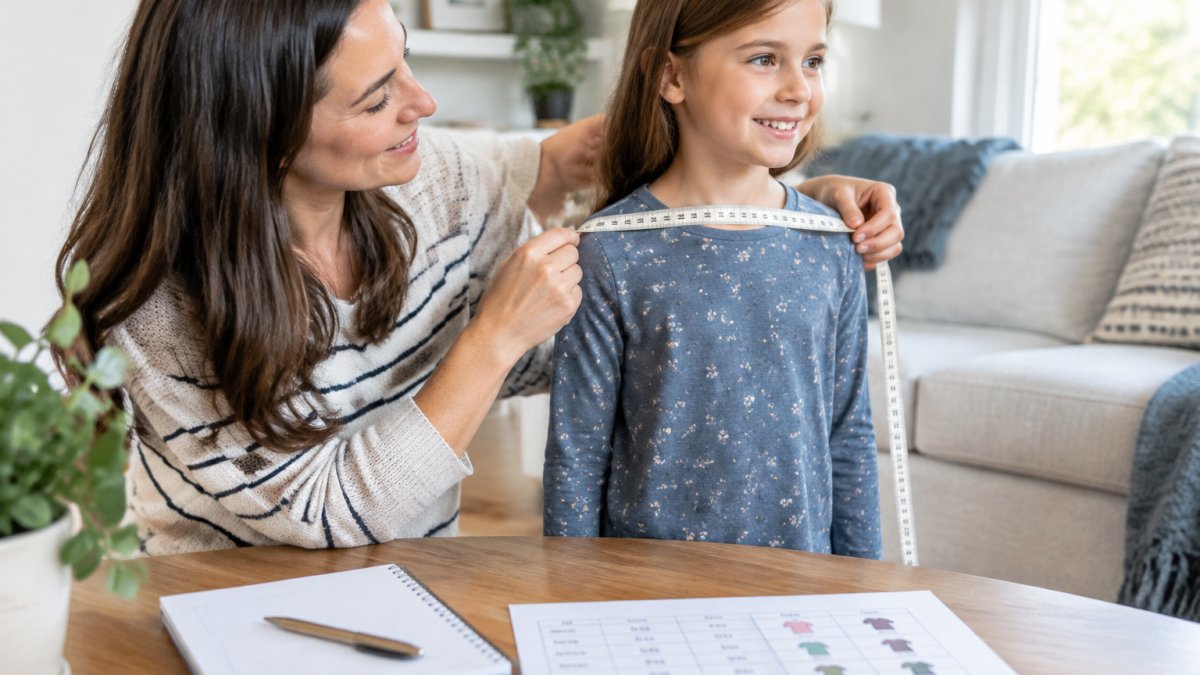
You need a soft tape measure and a helper. That is it.
- Chest: around the fullest part, tape level.
- Waist: at the natural waistline, not where your pants sit.
- Hips: around the widest point.
Measure over light clothing, not a bulky sweatshirt, and write the numbers down. Measuring once and never again is why the next order feels off.
How to Buy Clothes Online That Fit: Match Measurements to the Size Chart
The best way to buy clothes online that fit is to compare your body measurements to the garment measurements listed for the piece, not your usual size. A size chart should state what the finished garment measures, not just which body it is meant for.
Garment Measurements vs. Body Measurements
Garment measurements describe the piece laid flat; body measurements describe you. The gap between them is ease, and it is the number most size charts leave out.
Here is how to use both:
- Find the size chart on the product page. If it only lists body ranges (for example, "Chest 38-40 in."), look for a separate garment-measurement or "flat measurements" tab.
- Compare your chest and waist numbers to the chart's body ranges.
- Check the garment measurements for ease, a loungewear top needs more room than a fitted tee.
- Size up between two sizes if you want a relaxed fit.
A Repeatable Measurement Workflow
Do this once per brand, then keep the numbers.
Step 1, Measure your body. Use a soft tape measure over light clothing, level and snug but not tight.
Step 2, Measure a garment you already own and love. Lay your best-fitting piece flat.
Step 4, Read the ease. A fitted tee might have 2-4 in. at the chest, a relaxed sweatshirt 6-8 in., a coat 8-10 in. or more.
Step 5, Check the fabric's stretch. A knit with 5% spandex forgives a tighter measurement than a woven cotton with no stretch.
Worked Examples by Garment Type
A fitted t-shirt. Body chest 38 in. Chart says size medium fits chest 38-40 in.
A pair of joggers. Body waist 32 in., hip 40 in. Chart lists size medium for waist 31-33 in.
A kids' cardigan. Child height 48 in., chest 26 in.
A dress with no stretch. Body bust 36 in., waist 29 in. Chart lists size small for bust 34-36 in.
When the Chart Is Missing or Vague
Some product pages list only "S, M, L" with no measurements. Look for a size guide link, a fit note ("runs small," "true to size"), or reviews that mention height and weight.
For a worked example of matching body numbers to a specific garment's chart, see our guide on how to choose the right size for a UT Kids Varsity Cardigan.
How to Tell If Clothes Are Good Quality Online: Fabric, Stitching, and Seams
You can judge quality from a product page if you know where to look. Start with three things: fabric composition, stitching, and seams.
Fabric composition is the percentage breakdown on the label; it tells you how the piece will feel and wear. Stitching is the thread work visible in close-up photos. Seams are where panels join, and they take the most stress.
The inside finish matters as much as the outside: clean, flat inner seams will not rub against skin, while loose, frayed edges will.
- Look for even, tight stitching in zoomed photos.
- Check that patterns line up at the seams.
- Look for a lining in anything sheer.
Reading Fabric Composition and What It Means for Comfort
Natural fibers like cotton, wool, silk, and linen breathe well and feel soft. Synthetics like polyester, nylon, and spandex add stretch and durability but can trap heat. Rayon drapes nicely but needs gentler care.
For babies and kids, softness matters most. Our guide to the best soft fabrics for baby clothes goes deeper on which materials suit sensitive skin.
Kids Clothing Fabric Safety and Durability: What Parents Should Verify
For children's clothing, check two things beyond fit: fabric safety and durability. Look for clear material disclosures on the product page.
Durability shows in the details: reinforced seams, sturdy snaps, and smooth zippers signal a piece built to survive repeated washing.
Watch out: some listings claim certifications without linking to proof. Our article on how to identify authentic GOTS certified clothing walks through that check step by step.
How to Shop Online for the First Time: Reviews, Photos, and Seller Trust
Shopping online for the first time comes down to trusting the right signals. Customer photos beat studio shots every time, because real buyers show how a garment actually fits and drapes.
Read reviews for fit clues, not just star ratings, comments about sizing up or down, shrinkage, and comfort. Check the seller too: a secure website, clear contact details, and a visible return policy are baseline trust markers.
Spotting Unreliable Reviews and Misleading Product Photos
A cluster of five-star reviews posted on the same day is a red flag. So is a review that praises a product but never mentions fit or fabric. Real feedback tends to be specific.
Product photos can mislead too. Watch for heavy filtering that hides true color, and for shots that never show the back or the inside. If every photo is a styled flat-lay, you are not seeing how the piece moves.
Returns, Shipping, and Consumer Protections to Confirm Before Checkout
Confirm the return window, who pays return shipping, and whether exchanges are free before you order, these three details decide what a bad fit actually costs you. Reading the policy after something goes wrong is the worst time to discover a final-sale exclusion or a restocking fee.
Read the Return Policy by Scenario, Not by Headline
A "30-day returns" banner hides the details that matter. Read the full policy and map it to these scenarios:
Scenario 1, The item does not fit. Check whether the return window starts from the delivery date or the order date; a 30-day window from the order date can shrink to 20 days or less once shipping is subtracted. Confirm who pays return shipping: some sellers provide a prepaid label, some deduct the cost from your refund, some require you to pay upfront. A $7-$10 charge on a $30 item changes whether the purchase is worth the risk.
Scenario 2, The item is final sale. Final-sale items are commonly excluded from returns and exchanges. Look for the words "final sale," "clearance," or "no returns" on the product page, not just in the policy footer.
Scenario 3, The item arrives damaged or wrong. This is a seller error, not a fit return, and most policies treat it differently.
Scenario 4, The item is a gift or a multi-item order. If you bought several sizes intending to keep one, confirm whether the seller allows partial returns and whether returning multiple items in one box affects the refund.
Refund Timing and What to Expect
A refund is not instant: you ship the item back, the seller receives and inspects it, then issues the refund, and your card issuer's schedule may add further time.
Watch out: some policies reduce the refund by a restocking fee or by the original shipping cost, even when the return itself is "free." Read the refund calculation, not just the return window.
Shipping Costs, Delivery Windows, and Order Timing
If you need something for a specific date, check the stated shipping window and order with buffer room. "In stock" does not mean "arrives fast": processing time (order to shipment) is often separate from transit time, and both count against your deadline.
Check these before checkout:
- Processing time: how many business days before the order ships.
- Transit time: the carrier's estimated delivery window, not a single date.
- Shipping cost: free-shipping thresholds can push you to add items you do not need. Compare the shipping cost to the item price.
Consumer Protections and What to Document
Keep records of your order to support any future claim. The practical takeaway: keep records.
If an order goes wrong, document it in this order:
- Photograph the item and packaging as soon as it arrives if there is any damage or discrepancy.
- Contact the seller in writing, email or chat, so there is a record. State the order number, the problem, and the resolution you want.
- Note the dates. Most policies have a reporting window for damage or wrong-item claims, so check the window before you ship anything back.
- Keep the return tracking number if you ship something back.
- Escalate to your card issuer if the seller does not resolve the issue. Many card issuers offer dispute rights for items that never arrived or arrived not as described, and the dispute window is typically measured in months, not days.
Read the seller's policy in full. You can review the Coordinates return policy to see exactly how returns and exchanges work here.
Your Pre-Checkout Checklist for Buying Clothes Online
Run this list before you pay. It takes two minutes and prevents most regret.
| Check | What to Confirm | Why It Matters |
|---|---|---|
| Measurements | Your numbers vs. the size chart | Prevents fit surprises |
| Fabric | Composition and feel | Comfort and care needs |
| Construction | Stitching, seams, closures | Long-term durability |
| Reviews | Fit and quality comments | Real-world signals |
| Seller | Contact info and secure checkout | Basic trust |
| Returns | Window and shipping cost | Cost of a bad fit |
| Shipping | Delivery window | Arrives when you need it |
- Measured chest, waist, hips, and inseam
- Compared numbers to the garment size chart
- Read the fabric composition
For judging print quality from photos, our guide on how to spot high-quality screen printing on apparel is a useful next read.
Buying clothes online does not have to be a gamble. The families we work with want pieces that fit right, feel soft, and hold up through every wash and every holiday photo.
Frequently Asked Questions
What should I check first before buying clothes online?
Start with the size chart and your own measurements. Measure your chest, waist, hips, and inseam, then compare them to the garment's listed measurements rather than assuming your usual size. After sizing, read the fabric composition and care instructions, look at customer photos, and confirm the return window and who pays return shipping. These checks take about ten minutes and prevent most of the returns that make buying clothes online frustrating.
How can I tell if kids clothing fabric is safe and durable from an online listing?
Look for the fabric composition and care instructions in the listing. Cotton and cotton blends breathe well and hold up to repeated washing, while very thin polyester can pill and trap heat. Check whether the brand describes its flammability testing or safety compliance for children's sleepwear. Read reviews that mention shrinkage, pilling, or scratchiness after several washes, and inspect close-up photos for finished seams and secure snaps.
How do I know an online clothing store is trustworthy?
Check for a secure checkout (look for the padlock and an https address), a physical business address, a working phone number or email, and a return policy written in plain language. Search the brand name alongside the word reviews to see what buyers say outside the site. Be wary of listings with only stock photos, no size chart, and vague shipping times. A store that publishes clear contact details and return terms is usually safer to order from.
What is the 3-3-3 rule for clothing?
The 3-3-3 rule is a wardrobe guideline, not a sizing rule: before buying a piece, ask whether you can style it three ways, wear it three seasons, and keep it for three years. Applied to online shopping, it is a useful filter. If a garment only works with one outfit or looks unlikely to survive a year of washing, skip it. It pairs well with the practical checks, like fabric quality and return terms, that decide whether an order is worth placing.


