Softness in baby fabric comes down to three measurable things: fiber content, weave density, and what textile specialists call the "handle", how the cloth feels when you fold, stretch, and rub it between your fingers. A fabric can be 100% cotton and still feel scratchy if the fibers are short-staple or the weave is too tight.
Newborn skin is thinner than adult skin and loses moisture faster, so rough fibers and residual chemical finishes cause more irritation than they would on an adult (PubMed). This guide from Coordinates breaks down the best soft fabrics for baby clothes that actually earn a place in your baby's drawer, and which ones only sound gentle on the label.
Fiber Content, Weave Density, and Textile Handle
Fiber content tells you what the yarn is made of. Weave density tells you how tightly those yarns are packed. The handle is the result of both, plus any finishing treatments applied at the mill.
Long-staple cotton, merino wool, and bamboo viscose all start soft. What separates them is how they hold up after laundering and how they manage moisture against skin. A looser weave like muslin or gauze breathes better but pills faster. A denser jersey knit feels smoother but traps more heat.
Organic Cotton vs Bamboo for Babies: Softness, Breathability, and Cost
Organic cotton wins for most families. It's breathable, hypoallergenic, widely available, and holds its softness through repeated washing. Bamboo viscose feels silkier out of the package, but it's a chemically processed fiber, and that initial softness fades faster.
Here's the honest split:
Organic cotton: Grown without synthetic pesticides, breathable, durable, and gentle on delicate skin. Costs more than conventional cotton but less than specialty fibers.
Bamboo viscose: Soft and moisture-wicking, but the viscose process uses heavy chemical solvents, and the fabric tends to pill and stretch out.
Merino wool: Excellent for temperature regulation and thermal comfort, but pricier and requires careful laundering.
If you're comparing organic cotton vs bamboo for babies, the deciding factor is usually durability. Cotton survives the wash cycle. Bamboo often doesn't.
Christmas Bold Plaid Onesie (Baby)
Where Bamboo Viscose Falls Short
Bamboo viscose loses shape faster than cotton, especially in thin knits. It also absorbs moisture well but dries slowly, which matters for overnight wear. For swaddling or everyday onesies, cotton blends hold up better.
Best Baby Clothing Materials for Eczema and Delicate Skin
Eczema and sensory sensitivity are not the same problem, and the fabric that helps one can aggravate the other. Eczema is an inflammatory skin condition where the barrier function is compromised; the goal is to reduce friction, heat, moisture, and chemical irritants. Sensory processing differences are about how the nervous system interprets texture and fit; the goal is predictability and low tactile noise. Most babies with one have some degree of the other.
What Actually Triggers Flare-Ups
Friction. Rough fibers and bulky seams abrade already-compromised skin. Flatlock seams and tagless necklines matter more than the fiber name on the label.
Heat and trapped moisture. Synthetic fibers and tight weaves hold warmth and sweat against skin. Moisture sitting on an eczema patch is a common trigger.
Chemical residues. Dyes, formaldehyde-based finishes, and sizing agents left from manufacturing are frequent contact irritants. This is where certification (see the section above) does real work.
Rough texture. Wool in coarse gauges, embroidered appliqués, and stiff trims are common culprits for sensory-sensitive babies.
Fabrics That Tend to Work
100% organic cotton, long-staple, in a jersey or rib knit. Smooth, breathable, and predictable wash after wash. Long-staple fiber reduces the short fiber ends that create surface roughness.
Cotton-spandex blends (typically 95/5). The small amount of spandex keeps the garment from ballooning and reduces the loose fabric that bunches and rubs. A common pattern is that parents of eczema babies prefer a snug-but-not-tight fit over a loose one, because loose fabric moves against skin.
Fine-gauge merino wool. Not all wool is scratchy. Merino fibers are finer than standard wool, and fine-gauge knits worn over a cotton base layer work well for cold-weather babies who react to synthetic fleece.
Muslin and gauze. Excellent for swaddling and warm-weather layers because the open weave breathes. Less ideal as a base layer for eczema because the loose weave can pill and the texture is less smooth.
Fabrics to Approach With Caution
Polyester, nylon, and acrylic. Low breathability, high heat retention, and a tendency to hold static and moisture against skin.
"Fleece" without a fiber breakdown. Often polyester. Fine as an outer layer over cotton, problematic as a base layer.
Heavily dyed or printed knits. More dye means more potential residue. If a baby is actively flaring, plain undyed or light-colored cotton is the safer starting point.
Coarse wool and wool blends with synthetic content. The fiber ends and the synthetic component both work against sensitive skin.
A Practical Test Before You Commit
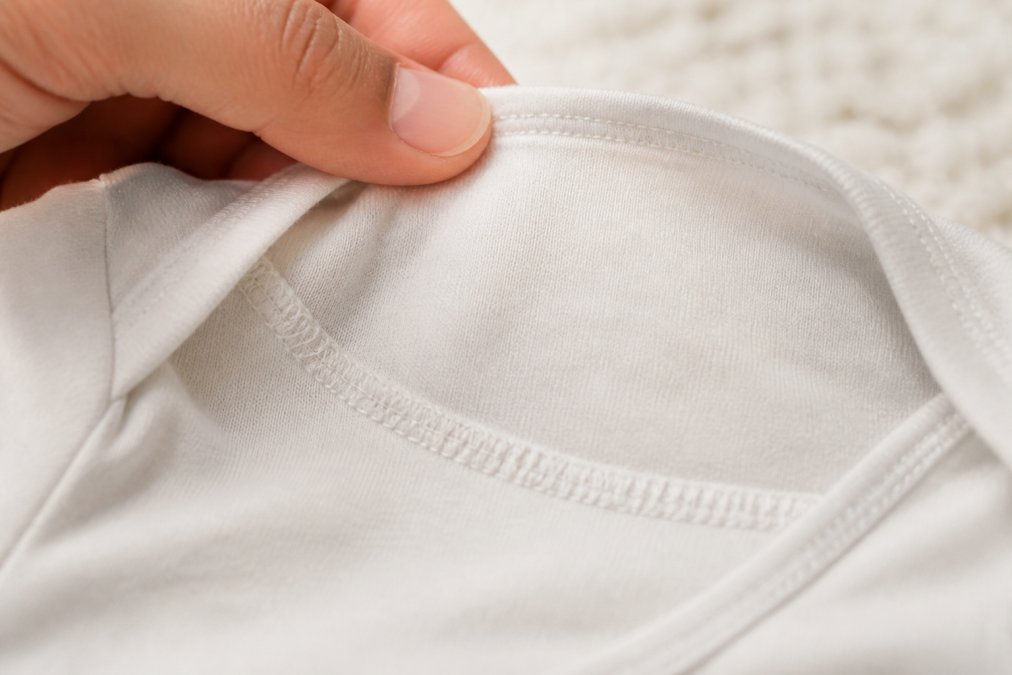
Before buying a full set, rub the fabric against the inside of your own wrist for ten seconds. Then check the seams, run a finger along the inside of the shoulder and side seam. If you can feel a raised ridge, a baby will too. Look for flatlock or coverstitch seams on anything worn against skin.
Pro TipFor sensory-sensitive babies, buy two or three identical pieces in the same fabric and color rather than a variety. Predictability reduces resistance at dressing time, and a familiar texture is easier to accept than a new one every day.
Close-up of flatlock seam on the inside of a baby onesie, showing smooth finish against skin
How to Wash Baby Clothes for Sensitive Skin
Wash baby clothes for sensitive skin with a fragrance-free, dye-free detergent, in warm water, on a gentle cycle, then double-rinse. Skip fabric softener entirely, it coats fibers with a waxy film that reduces absorbency and traps irritants.
A practical routine:
Sort by fabric type and color
Use half the recommended detergent dose
Add an extra rinse cycle
Tumble dry low or line dry
Avoid dryer sheets
Laundering Instructions by Fabric Type
Fabric
Water Temp
Dry Method
Watch Out For
Organic cotton
Warm
Tumble low
Shrinking on first wash
Cotton-spandex blend
Warm
Tumble low
Heat damage to stretch
Bamboo viscose
Cold
Line dry
Pilling, shape loss
Merino wool
Cold, wool cycle
Flat lay
Felting from agitation
Muslin / gauze
Warm
Tumble low
Snags, loose threads
Fabric Safety Certifications and What They Actually Test For
A certification is the only independent check on a fabric claim. The word "organic" on a hangtag is a marketing term until a third party verifies it, and "soft" is not regulated at all. For parents worried about chemical residues against newborn skin, these are the labels worth knowing.
OEKO-TEX Standard 100
This is the certification you will see most often on baby clothing, bedding, and muslin. It tests the finished textile, not the raw fiber, for harmful substances, including formaldehyde, heavy metals such as lead and cadmium, certain azo dyes that can release carcinogenic amines, pesticide residues, and chlorinated phenols (oeko-tex.com). The standard sets limit values by product class, and Product Class I is the strictest tier, reserved for items that come into direct contact with babies and toddlers. If a garment carries Standard 100, look for the class designation; Class I is what you want for anything worn against skin.
What it does not do: Standard 100 says nothing about how the fiber was grown, whether the mill treats wastewater, or whether workers were paid fairly. It is a chemical-safety screen, not a sustainability claim.
GOTS (Global Organic Textile Standard)
GOTS is the stricter and broader label. It requires a minimum percentage of certified organic fiber (95% for the "GOTS" grade, 70% for "made with organic"), then layers processing criteria on top: restricted chemical inputs at every stage from spinning to finishing, no chlorine bleaching, wastewater treatment requirements at wet-processing units, and social compliance criteria for workers. A GOTS-certified garment is therefore both organic at the fiber level and screened for chemical inputs during processing.
Bluesign is a system-level certification aimed primarily at textile manufacturers rather than finished consumer goods. It screens chemical inputs, resource use, and emissions across the supply chain. You will see it more often on outdoor and performance apparel than on baby basics, but when it appears on a baby product it signals that the mill's input chemicals were vetted upstream.
How to Read a Hangtag in Ten Seconds
Look for a certification number or license ID, not just a logo. GOTS and OEKO-TEX both issue traceable IDs that can be verified on the certifying body's website.
Check the product class on OEKO-TEX. Class I for baby items.
Treat "chemical-free" and "non-toxic" as unverified unless a certification backs them. Neither is a regulated claim.
Distinguish fiber certification from finished-goods certification. A GOTS-certified fabric can still be sewn with conventional thread and trim; a GOTS-certified garment covers the whole item.
If you only remember one thing: OEKO-TEX Standard 100 Class I screens the finished fabric for harmful residues, and GOTS covers organic fiber plus processing. A garment carrying both is about as verified as baby clothing gets.
Sustainability vs Durability: Which Soft Fabrics Last Long Enough to Matter
The greenest fabric is the one you don't have to replace. That's the tension most buying guides ignore: a bamboo viscose onesie may have a lower initial environmental footprint, but if it pills and stretches after ten washes, you're buying three of them.
Organic cotton costs more upfront and lasts longer. Merino wool lasts years if you care for it properly. Muslin wears thin quickly. When you weigh sustainability against durability, the fabric that survives the most wash cycles usually wins on both counts.
Upcycling matters here too. Cotton onesies that have stretched out can be cut down for doll clothes or donated. Bamboo and synthetic blends are harder to recycle.
Soft Baby Fabrics in Practice: What Coordinates Uses
At Coordinates, we build our baby pieces around cotton-spandex blends and 100% cotton because those fibers hold their softness through the wash cycle without trapping heat. Our Christmas Soft Plaid Onesie uses a 95% cotton, 5% spandex blend with a full zipper for diaper changes, and the University of Texas Inspirational Button Down Set is made from 100% cotton for breathability against delicate skin.
University of Texas Inspirational Button Down Set (Baby)
The blend matters for a reason. Pure cotton feels great but loses shape at the neckline and cuffs. Adding a small percentage of spandex keeps the fit snug without squeezing, which is why the Christmas Bold Plaid Onesie and the Team USA Plaid Onesies both use the same 95/5 formula. Ribbed cuffs hold without pinching, and the full-length zipper means you're not wrestling a wriggling baby out of a neck opening at 3 a.m.
If your baby runs hot, cotton-spandex beats fleece every time for sleepwear. The spandex keeps the garment from ballooning, and the cotton moves moisture away from skin instead of trapping it.
Conclusion
Choosing the best soft fabrics for baby clothes comes down to matching fiber to your baby's skin, your climate, and how many washes you're willing to put a garment through. Organic cotton and cotton-spandex blends cover most needs; merino handles cold weather; bamboo looks good on paper but rarely survives the long haul.
Picking the right fabric is only half the job. The other half is finding pieces that hold up, fit correctly across every size, and don't irritate skin after the third wash. Coordinates builds family loungewear around soft, breathable cotton blends, with sizes running from newborn through adult and matching options for the dog. Start with the Christmas Snowflake Onesie or browse the full collection to see what coordinates with your family's holiday lineup.
Christmas Snowflake Onesie (Baby)
Frequently Asked Questions
What is the softest fabric for baby clothes?
Organic cotton and bamboo viscose are the two softest options for baby clothes. Organic cotton is hypoallergenic and breathes well, which helps with temperature regulation during sleep. Bamboo viscose has a silkier, cooler feel but loses some softness over repeated washing. Merino wool is another contender for thermal comfort in cooler months, though it costs more. For most parents, a 95% cotton and 5% spandex blend delivers the best balance of softness, stretch, and durability.
Is organic cotton or bamboo better for babies?
It depends on your priority. Organic cotton is grown without synthetic pesticides, is breathable, and holds up well through frequent laundering. Bamboo viscose feels softer initially and wicks moisture, but the manufacturing process uses more chemicals and the fabric can pill over time. For babies with eczema or very sensitive skin, organic cotton is usually the safer starting point because it is hypoallergenic and free from chemical finishing agents that can trigger irritation.
Are synthetic fabrics safe for baby skin?
Synthetic fibers like polyester and nylon are not inherently toxic, but they trap heat and moisture against the skin, which can worsen irritation for babies prone to eczema or heat rash. They also lack the breathability of natural fibers. If you do use synthetics, look for moisture-wicking blends designed for active wear and avoid them for sleepwear or extended contact. Natural fibers remain the better choice for daily wear against delicate skin.
How should I wash baby clothes for sensitive skin?
Use a fragrance-free, dye-free detergent and skip fabric softener entirely, since both leave residue that can irritate delicate skin. Wash new clothes before the first wear to remove any manufacturing finishes. Turn garments inside out, use cold or warm water on a gentle cycle, and tumble dry on low. For eczema-prone babies, an extra rinse cycle helps strip leftover detergent. Avoid dryer sheets and opt for wool dryer balls instead.