

Posted by Editorial Team
on October 25, 2026

Last Updated: October 24, 2026
Quick Summary
How to organize and store family loungewear starts with sorting and decluttering your collection, then folding pieces consistently and assigning each family member their own storage zone based on how often they wear each piece. Keep matching sets together, rotate seasonal loungewear twice yearly, and store off-season pieces in labeled bins in cool, dry spaces away from light and heat.
- Organize by family member first, then group loungewear by type within each person's section using shelf dividers
- Store daily pajamas at waist to eye level, seasonal pieces on high shelves, and kids' everyday loungewear at low reach height
- Clean loungewear completely and let it cool before storing to prevent stains from oxidizing and fabric from yellowing
- Rotate loungewear twice yearly in spring and fall, inspecting each piece and moving clean off-season items into labeled storage bins
- Keep only two to three everyday sets per person in active storage and rotate the rest out to prevent drawers from overflowing
Table of Contents
- Why Family Loungewear Organization Matters
- Sort and Declutter Your Loungewear Collection
- How to Fold Pajama Sets for Easy Storage
- Family Closet Organization for Coordinated Pieces
- Small Closet Clothing Storage Ideas for Loungewear
- Keep Matching Pajama Sets Together and Accessible
- Seasonal Rotation and Long-Term Care for Loungewear
- Create Your Family Loungewear Storage System
- Frequently Asked Questions
Why Family Loungewear Organization Matters
Learning how to organize and store family loungewear changes how your mornings feel. When pajamas are scattered across drawers, kids can't find matching sets, you waste time digging through piles, and quality pieces get wrinkled or lost.
At Coordinates, we understand that family loungewear isn't just about comfort, it's about creating moments together. Whether you're coordinating matching sets for the holidays or keeping everyday pajamas accessible, a solid system saves time and protects your investment.
The real benefit? Your family gets ready faster, kids find their own clothes, laundry day becomes simpler, and those special matching sets stay in good condition longer because they're stored properly.
A thoughtful approach also means you can see what you own. Many families buy duplicates simply because they forgot what was in the closet; with a clear system, you know exactly what loungewear you have and where it is.
Sort and Declutter Your Loungewear Collection
Before you organize, you need to see what you're actually working with. Pull every pajama set and loungewear piece from your drawers and closet. Lay them out on a bed or clean surface so you can assess the full collection.
As you sort, ask honest questions about each piece. Does it still fit? Is the fabric holding up? Do your kids actually wear it? Be willing to let go of pieces that no longer serve your family.
Group items by category as you sort:
- Everyday loungewear your family wears regularly
- Holiday or special occasion sets you wear a few times per year
- Seasonal pieces (lightweight for summer, heavier for winter)
- Pieces that need repair or are worn out
This step clarifies how much storage space you actually need. Many people realize they have far less loungewear than they thought once they eliminate duplicates and worn-out pieces.
How to Fold Pajama Sets for Easy Storage
Folding matters more than you'd think. The right technique keeps garments wrinkle-free and easier to find in a drawer.
For pajama tops, lay the shirt flat with buttons facing down. Fold one sleeve across the front, then back at a right angle toward the center; repeat on the other side. Fold the bottom up toward the neckline for a neat rectangle that stands upright in a drawer.
For pajama pants, lay them flat with one leg on top of the other. Fold lengthwise so both legs align. Fold in half at the waist. This creates a compact rectangle that stores easily.
The key is consistency. When every piece is folded the same way, they stack neatly and you can see all your options at a glance.
Some families prefer rolling, especially for casual loungewear or tight drawer space. Roll each piece tightly from the bottom up; rolled pieces take up less vertical space and can be stacked or stored in bins.
Test both methods. The best folding technique is the one you'll actually use every time.
Family Closet Organization for Coordinated Pieces
A family closet system keeps matching sets together and makes getting dressed faster. It works best with dedicated closet space, even a small section of a shared closet.
Organize by family member first. Give each person their own section or shelf. Within that section, group loungewear by type: everyday pajamas together, holiday sets together, seasonal pieces separate.
Use shelf dividers to keep stacks from toppling. They cost just a few dollars and prevent the domino effect when you pull out one piece.
For matching sets that coordinate across multiple people, hang them on a single rod or shelf. This visual reminder shows everyone the matching options and prevents one family member from breaking up the coordinated look.
Label shelves or sections. A simple label helps kids find their own loungewear without asking, building independence and reducing morning friction.
Keep frequently worn pieces at eye level and seasonal pieces higher or lower; whatever your family reaches for most should be easiest to access.
Small Closet Clothing Storage Ideas for Loungewear
Small closets fail for a predictable reason: loungewear is bulky, and most families try to store it in the same prime space as everyday clothing.
Start with a simple inventory of your space.
Zone 1: Prime reach (waist to eye level). Daily pajamas and everyday loungewear go here.
Zone 2: High shelf (above eye level). Reserve this for seasonal or occasional pieces: holiday matching sets, thick fleece, and guest loungewear.
Zone 3: Low shelf or floor (below knee level). Kids' everyday loungewear belongs here if they can crouch, or on a low hook if not.
Zone 4: Door back. An over-the-door organizer is the highest-yield square footage in a small closet because it uses otherwise dead space.
Zone 5: Under-bed and vertical dead space. Flat under-bed bins work for off-season loungewear if the bin is shallow enough to slide under the frame, typically 6 to 8 inches tall. Avoid stacking heavy bins on high shelves where they are hard to pull down safely.
Legacy Plaid Swaetshirt (Unisex) →
A few trade-offs are worth naming. Vacuum bags compress bulky fleece dramatically but crease fabrics and trap musty odors if pieces go in even slightly damp, use them only for truly off-season items.
The goal in a small space is not to store everything. It is to keep the pieces your family actually wears within reach and move the rest to secondary storage.
Organize small closets by assigning loungewear to zones based on how often each piece is worn.
| Zone | Location | Best For | Access Height |
|---|---|---|---|
| Zone 1 | Waist to eye level | Daily pajamas and everyday loungewear | Easy reach |
| Zone 2 | Above eye level | Seasonal and occasional pieces | High shelf |
| Zone 3 | Below knee level | Kids' everyday loungewear | Low reach |
| Zone 4 | Door back | One folded set per pocket | Variable |
| Zone 5 | Under-bed storage | Off-season loungewear | Floor level |
Keep Matching Pajama Sets Together and Accessible
Matching sets deserve special care because they're only useful when both pieces stay together; separate a top from its bottom and you've lost half the value.
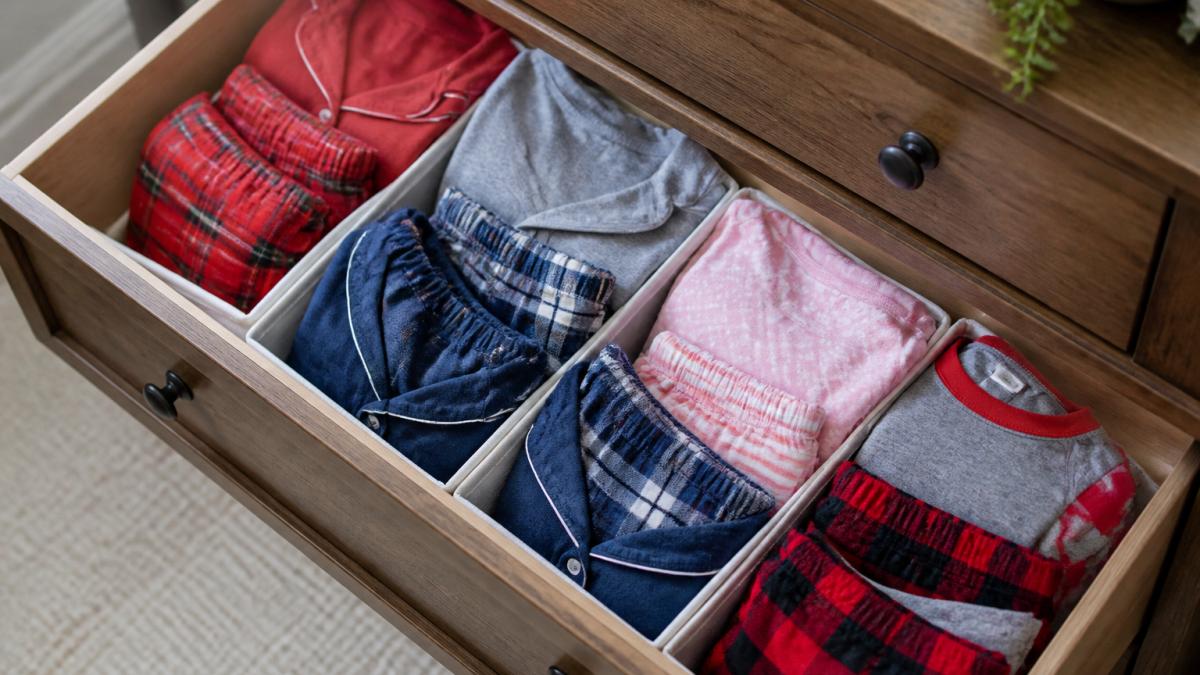
Store matching sets in the same location: fold both pieces together, or use a small basket or bin to keep the set as a unit.
Label sets if you have multiple matching collections. A small tag or sticker on the inside of the top piece identifies the set. This prevents pieces from getting mixed up during laundry or when family members are grabbing items in a rush.
Consider the Buy High Quality Family Matching Loungewear Online options available so you can invest in durable sets that justify the organizational effort.
Create a designated shelf or drawer section just for coordinating pieces. When matching sets have their own space, they stay together naturally. Kids know exactly where to find them for family photos or special occasions.
For holiday or special occasion sets, store them separately from everyday loungewear. This protects them from frequent washing and wear. A clear bin on a high shelf keeps these pieces visible but out of the daily rotation.
Seasonal Rotation and Long-Term Care for Loungewear
Most organization guides stop at folding. The part that protects your investment is what happens between seasons: how you wash, pack, label, and rotate loungewear so it comes back out in wearable condition.
Set a rotation calendar. Rotate twice a year, in spring and fall, when temperatures shift enough that your family stops reaching for the other weight. Put the date on your phone calendar.
Clean before you store, every time. Body oils, deodorant residue, and invisible food stains oxidize over months and can yellow or weaken fabric. If a piece needs repair, fix it before storage rather than after, when a small hole may have grown. Learn how to repair and mend worn loungewear to extend the lifespan of your pieces.
Match the container to the fabric. Breathable cotton and modal do well in canvas bins or cotton storage bags.
Control light, heat, and pests. Store bins in a cool, dry interior closet rather than a garage, attic, or sunny shelf. Prolonged light fades colors and degrades elastic; heat and humidity encourage mildew and pests.
Refresh, do not just retrieve. When a bin comes back into rotation, unfold and refold each piece, check seams and elastic, and air out anything stale.
Keep a small active set. You do not need every piece accessible at once. A workable rule is two to three everyday sets per person in active storage and the rest rotated out.
Create Your Family Loungewear Storage System
Your approach to how to organize and store family loungewear should match your family's actual habits, not some perfect ideal. Observe how your family uses loungewear: do kids grab their own clothes?
Build your system around these realities. If your kids dress themselves, store loungewear at their height.
Start simple. Choose one storage method: folding, rolling, or a combination. Pick one location for each family member's loungewear. Use one type of divider or container.
Label everything clearly. Kids benefit from visual labels showing where each type of loungewear goes. Adults appreciate labels that prevent confusion about which pieces are whose.
Test your system for two weeks. Can everyone find what they need? Are pieces staying together? Adjust based on what you learn.
Document your system. Take a photo of your organized loungewear storage. When pieces get scattered during busy weeks, you have a visual reminder of how it should look.
Remember that organization isn't about perfection. It's about making daily life easier.
The Why Choose High Quality Loungewear: A 2026 Guide explains why investing in quality pieces makes the organization effort worthwhile.
Frequently Asked Questions
What's the best way to keep matching family loungewear sets together?
Bundle each pajama set with a small elastic band or store them in individual small baskets or drawer dividers. This prevents sets from separating in the wash or during daily use. Label each basket by family member or occasion (holidays, everyday, etc.) so everyone knows where their coordinated loungewear belongs. For matching sets from Coordinates like the Christmas Legacy Plaid Set, keeping them bundled preserves the coordination and makes getting dressed faster.
How should you organize clothes for a large family in a small closet?
Use vertical space with stacked shelves or hanging organizers, and assign each family member a designated section. Use drawer dividers to maximize dresser space, and store off-season loungewear in under-bed bins or a closet shelf. Rolling garments instead of folding can be a space-saving option. Group similar items together, all pajamas in one area, all loungewear tops in another, so family members can quickly find their pieces without searching through everything.
Should family loungewear be folded or rolled for storage?
Rolling is more space-efficient and works well for loungewear made from cotton-spandex blends like Coordinates pieces, which resist wrinkles. Fold larger items like hoodies or button-down tops, and roll jogger-style pants and lighter garments. Rolling also makes it easier to see all your options at once in a drawer or bin. For delicate embroidery or prints, fold gently rather than rolling to avoid creasing the design.
How do you organize clothes between laundry days to keep everything neat?
Assign each family member a small basket or bin in the closet or bedroom for worn but clean loungewear. After laundry, immediately fold and return items to their designated drawer sections or shelves. Keep a separate small bin for items awaiting washing. This prevents clean and dirty garments from mixing and keeps your storage system from looking chaotic. A quick 10-minute reset after each laundry day maintains the organization for the whole week.
Creating a loungewear organization system that actually works requires understanding your family's real habits and storage constraints. The most important step is starting with what you have, sorting ruthlessly, and choosing storage methods you'll maintain consistently. When your family's favorite pieces are easy to find and stay in good condition, you've built a system that serves everyone.


