

Posted by Editorial Team
on November 22, 2026

Last Updated: November 21, 2026
Quick Summary
To buy matching holiday outfits for kids, decide three things before you shop: your match level (identical, coordinated, or subtle), a palette limited to three colors with one neutral, and a per-person budget. Then buy the kids' anchor pieces first, since children's sizing and stock are the constraints you can't negotiate with.
- Choose coordinated matching over identical for the safest, most flexible family look.
- Measure chest, waist, and inseam at home and size against the event date, not today.
- Set a per-person ceiling and hold back 10 to 15 percent as an exchange buffer.
- Order kids' anchor pieces about four weeks out, then adult pieces a week later.
- Let kids wear sets for an hour at home before the event to prevent first-wear discomfort.
Ready to coordinate the whole family?Festive plaid sets for babies, kids, and adults, sized to match and made for cozy holiday memories.
Shop Holiday Sets
Table of Contents
- Start With a Plan: How Matching Holiday Outfits Actually Come Together
- Matching Christmas Outfits for Kids: Choosing a Shared Color or Print
- Comfortable Holiday Clothes for Kids: Fabric, Fit, and Sensory Needs
- Affordable Matching Christmas Outfits: Budgeting and Cost Per Wear
- Family Matching Holiday Outfits: Sizing, Growth, and Shopping Timeline
- Dress the Kids First, Then Build the Adults Around Them
- Shop the Coordinates Holiday Collection
- Frequently Asked Questions
Start With a Plan: How Matching Holiday Outfits Actually Come Together
The families who end up with photos they love don't shop by browsing. They shop by deciding first. Tips for buying matching holiday outfits for kids work best when you settle three things before you open a single product page: how closely the family should match, which colors or prints carry the look, and what the budget is per person. For a deeper walkthrough of sizing and styling strategy, see our guide to finding matching family outfits. The outfit is rarely the problem.
Here's the trap most parents fall into. They buy one adorable piece on impulse, then spend weeks trying to build a family around it. The result is a mismatched pile, three return labels, and a photo date creeping closer.
Below, we'll show you exactly how to plan the whole set in one sitting, including a shopping timeline, a budget method, and a sizing strategy that survives a growth spurt.
Pick Your Match Level Before You Shop
Match level is the single decision that shapes everything else. It answers one question: how obvious should the coordination be?
- Identical: everyone in the same print, same colorway. Highest impact, least flexibility.
- Coordinated: shared color family or one shared element, different cuts. The safest choice for most families.
- Subtle: one thread of connection, like a shared plaid accent or a common color in accessories. Best for families who dislike looking staged.
Most parents assume matching means identical. It doesn't. A coordinated look photographs just as well and gives each person room to look like themselves. If you want to see how far the subtle end of the scale can go, our guide to subtle matching family holiday outfits walks through seven ideas that coordinate without looking identical.
Pick your level now, in writing, before anyone opens a browser. Changing your mind mid-shop is how budgets break.
Matching Christmas Outfits for Kids: Choosing a Shared Color or Print
Start with the anchor piece, not the color palette. The anchor is the one item everything else answers to, usually the kids' set, because children's sizing is the least forgiving and the most time-sensitive. Once the anchor exists, the palette writes itself.
A plaid is the easiest anchor to build around because it already contains multiple colors. The Christmas Legacy Plaid Set (Kids) carries a red-and-green plaid with cream ribbed trim at the neckline, cuffs, waistband, and ankles, which gives you three colors to pull from for the adults.
For a bolder look, the Christmas Bold Plaid Set (Kids) features a bold Christmas plaid design with a half zipper, hooded top with kangaroo pockets, and ribbed cuffs.
Two rules keep this simple. Limit yourself to three colors total, and make one of them neutral. More than three and the group photo turns into visual noise.
Comfortable Holiday Clothes for Kids: Fabric, Fit, and Sensory Needs
Comfort decides whether the outfit survives past the first photo. A child who itches will tug at the collar in every frame, and no amount of coordination fixes that.
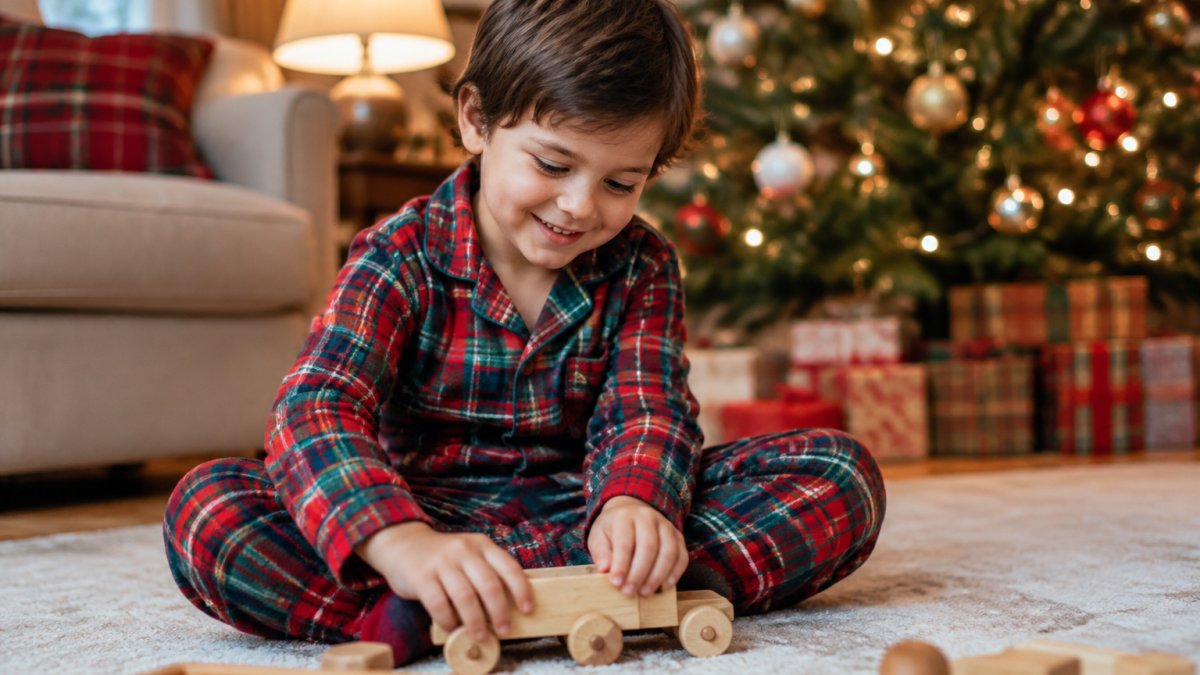
Fabric choice matters more than most parents expect. The Christmas Soft Plaid Set (Kids) is a soft, breathable plaid onesie that answers exactly this fabric and sensory brief.
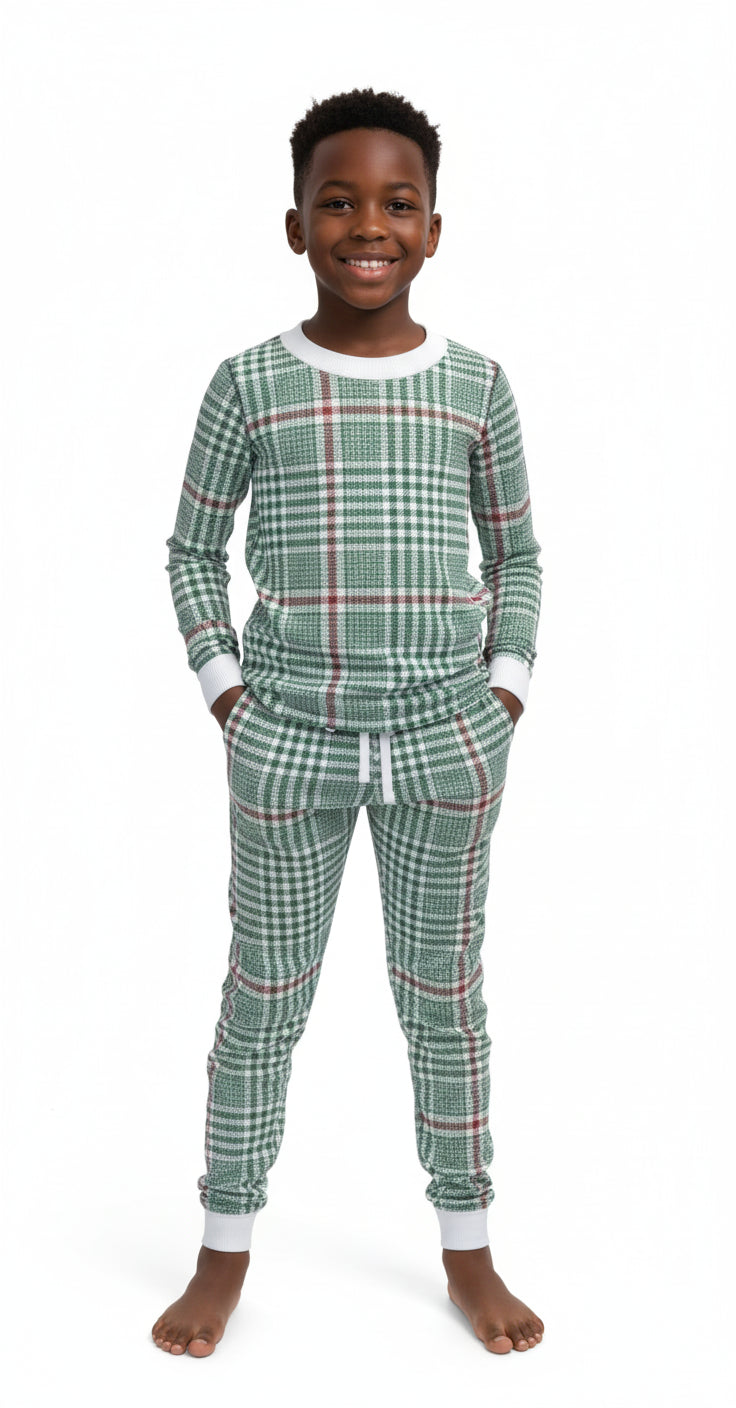
Fit is the second half of the equation. Look for:
- Elastic or drawstring waists that adjust rather than dig in
- Ribbed cuffs that stay put without squeezing
If your child has sensory sensitivities, let them wear the set for an hour at home before the event. A common mistake is saving the first wear for the photo itself. Break it in first.
Affordable Matching Christmas Outfits: Budgeting and Cost Per Wear
Affordable matching Christmas outfits are less about the sticker price and more about how many times each piece gets worn. That's the cost-per-wear test, and it changes which sets are actually worth buying.
Run the math before you commit. Divide the price by the realistic number of wears. A holiday set worn once for photos costs its full price per wear.
Build the budget in three layers. First, set a per-person ceiling and write it down before you shop; a household total is too easy to reallocate mid-browse. Second, separate the budget into anchor pieces (the kids' sets that drive the look) and supporting pieces (adult solids, accessories, layers). Third, hold back roughly 10 to 15 percent of the total as an exchange buffer, because a wrong size or a sold-out color is the most common reason a budget breaks late.
Three practical ways to protect the budget:
- Set a per-person ceiling before you shop, and write it down.
- Buy the kids' pieces first, since they're the least reusable year to year.
- Choose pieces that work beyond December, like loungewear that doubles as everyday comfort wear.
Reuse is where the real savings live. A plaid pajama set worn for Christmas morning photos can come back for movie nights and winter break mornings.
Watch out: buying identical outfits for a large family multiplies the per-person ceiling by the headcount fast.
For families dressing a crowd, our guide on how to dress a large family on a budget goes deeper on stretching the same budget across more people.
Family Matching Holiday Outfits: Sizing, Growth, and Shopping Timeline
Family matching holiday outfits live or die on sizing, and sizing is where most orders go wrong. Two things cause it: buying for the child in front of you instead of the child who'll be in the photo, and shopping too late to fix a mistake.
Measure at home with a soft tape, and write the numbers down. For kids, the three measurements that matter most are chest (around the fullest part, tape level under the arms), waist (at the natural waistline, not the hip), and inseam (crotch to ankle).
Order sizing around the event date, not today's date. Children grow between the order and the holiday, so check the size chart against current measurements and size up when a child sits between sizes.
Then protect yourself with the calendar and the return policy. Check the retailer's return policy before you order, and keep tags on until the try-on is done.
A Simple Shopping Timeline and Checklist
Work backward from your photo date or holiday gathering. This timeline assumes standard shipping, so add a buffer if you're ordering close to a peak week.
| When | Task | Why It Matters |
|---|---|---|
| 6 weeks out | Set match level, palette, and per-person budget | Locks the plan before impulse buys |
| 5 weeks out | Measure everyone, check size charts | Prevents the most common order error |
| 4 weeks out | Order kids' anchor pieces first | Kids' sizes sell out and ship slowest |
| 3 weeks out | Order adult pieces to match the anchor | Confirms palette availability |
| 2 weeks out | Try everything on, start exchanges | Leaves time for a replacement |
| 1 week out | Wash and break in the sets | Removes first-wear discomfort |
| Event week | Lay out full outfits the night before | Avoids the morning scramble |
- Match level chosen and written down
- Palette limited to three colors, one neutral
- Per-person budget set
- Current measurements taken for every family member
- Size charts checked, sizing up where between sizes
- Return window noted before ordering
- Order placed with buffer before the event
- Try-on completed with time for exchanges
- Sets washed and broken in
Watch out: ordering the kids' sets and the adult pieces in the same week feels efficient but removes your buffer, if the kids' anchor arrives in the wrong size, the adult pieces are already locked to a palette you may have to change. Stagger the orders as the timeline shows, and keep the tags on until the whole group has tried on together.
Shopping timeline: weeks before the event
Set match level, palette, and budget 6 weeks out
Measure everyone, check size charts 5 weeks out
Order kids' anchor pieces first 4 weeks out
Order adult pieces to match the anchor 3 weeks out
Try everything on, start exchanges 2 weeks out
Wash and break in the sets 1 week out
Dress the Kids First, Then Build the Adults Around Them
Dress the kids first. It sounds backward, since adults are easier to shop for, but children's sizing and stock are the constraints you can't negotiate with. Adults can adapt to almost any palette. A toddler's set cannot be resized on demand.
Once the kids' pieces are locked, adults have a clear brief: match the palette, match the dress level, and choose cuts that suit each body. This is where most families accidentally break the look.
Match the dress level across the group before you match the color. Decide whether the family is in loungewear, casual, or dressed up, then hold everyone to it.
For families with a wider age spread, including grandparents or relatives joining the photo, assign each person a role in the palette rather than an identical outfit. One neutral, one dominant color, one accent. Inclusive coordination across sizes and ages works when everyone has a defined part to play.
Shop the Coordinates Holiday Collection
The plan is done. Now the fun part. Our holiday collection is built for exactly this kind of coordination, with festive plaid sets designed to match across the whole family and sizing that runs from baby to adult, so one order covers everyone.
Every piece is inspired by family and made with love, from the soft cotton blend to the details that make the set comfortable for photos and bedtime. If you're shopping for the littlest members of the family, you can browse the kids' collection to find the coordinating pieces that anchor the whole look.
The hardest part of matching outfits isn't finding something cute. It's building a set that fits everyone, survives the season, and still looks coordinated in the photo.
Frequently Asked Questions
How do you coordinate holiday outfits for kids of different ages?
Pick one shared element, like a color, a plaid, or a trim detail, and let each child wear it in an age-appropriate cut. A toddler might wear a hooded plaid set with a half zipper, while a baby wears a simpler two-piece in the same print. Dress the youngest first, then build outward, so the smallest sizes are settled before you commit to the rest. This keeps the group photo cohesive without forcing a teenager into the same silhouette as a preschooler.
Are matching holiday outfits for kids comfortable enough to wear all day?
It depends on the fabric and fit. Look for breathable cotton blends with a little stretch, like the 95% cotton, 5% spandex used in Coordinates kids sets, and check for soft ribbed trim at the neck, cuffs, and waistband rather than stiff seams. An adjustable drawstring waist and functional pockets help too. If your child is sensitive to tags or tight cuffs, try the set on for an hour at home before the holiday event.
How much should I budget for affordable matching Christmas outfits?
Plan around cost per wear instead of the sticker price. A $39 kids set worn to bedtime, Christmas morning, family photos, and a holiday gathering spreads its cost across every wear. Set a total budget for the family, buy the kids' pieces first since they are the hardest to fit, and add adult pieces only after you know the sizes work. That order keeps spending controlled and avoids returns.
How far in advance should I order family matching holiday outfits?
Order at least three to four weeks before the event you are dressing for. That leaves room to try everything on, exchange a size if a child has grown, and still have the set ready for photos. Check the retailer's return policy before you buy, and keep tags on until the fit is confirmed. For Thanksgiving or Christmas morning, ordering in early November is a safe target.


