

Posted by Editorial Team
on October 29, 2026

Last Updated: October 29, 2026
Quick Summary
Holiday costumes can be safe for anxious dogs if they fit well, use breathable lightweight fabric, and leave the dog free to move, see, hear, and drink. Remove the outfit immediately at the first signs of stress, such as escape attempts, trembling, or freezing.
- Check that the costume does not pinch the armpits, rub the neck, or drag on the ground.
- Choose breathable, lightweight fabrics, since heavy synthetics trap heat and increase anxiety.
- Never let a costume cover the eyes or ears, or block panting and drinking water.
- Watch for freezing, lip licking, and pulling away, which are stress signs people often miss.
- Start costume training at least two to three weeks before the event, in short, rewarded sessions.
Table of Contents
- Why Holiday Costumes Can Be Hard on Anxious Dogs
- Dog Costume Safety Tips: Fit, Fabric and Movement
- Signs of Stress in Dogs You Should Never Ignore
- How to Get a Dog Used to Wearing Clothes Gradually
- When the Costume Should Come Off Right Away
- Dog Costume Alternatives for Anxious Pets
- Planning a Stress-Free Holiday Visit with Your Dog
- Frequently Asked Questions
Why Holiday Costumes Can Be Hard on Anxious Dogs
Holiday costumes look adorable on social media. For a nervous dog, though, a costume can feel like being wrapped in something strange and unpredictable.
Anxious dogs often read unfamiliar clothing as a threat. Fabric touching their body, a tight strap, or a sudden restriction can trigger a fear response.
- Clothing can restrict movement and make dogs feel trapped
- Strange textures can cause constant scratching or pulling
- Crowded parties add noise, lights, and visitors on top of the outfit
A common mistake is assuming a dog who seems calm at home will feel the same at a busy party.
Dog Costume Safety Tips: Fit, Fabric and Movement
Safety starts with fit. A costume should sit comfortably without pinching the armpits, rubbing the neck, or dragging on the ground.
Choose breathable, lightweight fabrics. Heavy synthetic materials trap heat, and a dog that overheats becomes more uncomfortable and more anxious.
Look for these safety basics before any costume goes on:
- Full range of movement for legs, neck, and tail
- Clear vision and hearing, with no fabric covering the eyes or ears
- Open access to the mouth for panting and drinking water
Watch out: a costume that snags on furniture or a fence can cause panic and injury, so supervise your dog closely while wearing one.
If you are looking for a soft option for your dog, the Christmas Doggie Hoodie is made from a 95% cotton and 5% spandex blend with a lined hood and a harness hole, sized XS to XL.

The article lists the key safety basics to check before any costume goes on:
| Safety check | What to look for |
|---|---|
| Movement | Full range for legs, neck and tail |
| Vision and hearing | Fabric must not cover the eyes or ears |
| Mouth access | Open for panting and drinking water |
| Small parts | No loose buttons or dangling accessories |
| Fabric | Breathable, lightweight materials such as soft cotton blends |
Signs of Stress in Dogs You Should Never Ignore
Stress shows up in body language before it turns into obvious fear. Learning these signals helps you remove the costume before your dog reaches a breaking point.
Common stress signals include:
- Yawning, lip licking, or turning the head away
- Ears pinned back or tail tucked low
- Panting when the dog is not hot or active
Freezing is a stress sign that people often miss. A dog that goes very still and stops responding to you may be overwhelmed, not calm.
How to Get a Dog Used to Wearing Clothes Gradually
Most anxious dogs do not fail at costumes because the costume is bad. They fail because the introduction was too fast. A reward-based desensitization plan works the same way it does for nail trims or harnesses: small exposures, paired with something the dog already loves, stopped before the dog shows stress.
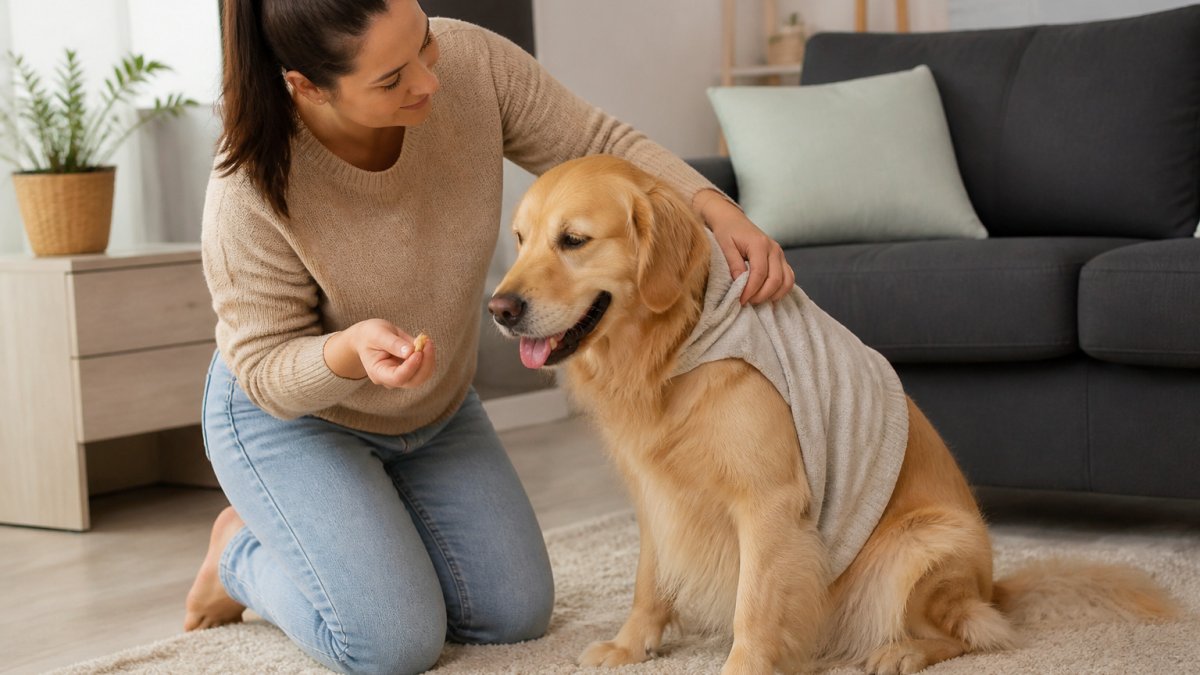
!Calm golden retriever sitting on a living room rug while its owner gently places a lightweight sweater on its back
Set up before you start
- Pick a low-distraction time and place, no visitors, no doorbell, no other pets competing for treats.
- Use a high-value treat the dog only gets during these sessions (freeze-dried liver, small pieces of cheese, or a lickable treat on a silicone mat).
- Keep sessions short and frequent.
The progression, with clear stopping points
Each step has a move-forward signal and a stop signal. Do not advance until the dog shows the move-forward signal on two separate sessions.
- See it. Place the costume on the floor a few feet away. Reward any calm look toward it, then reward looking away. Move forward when: the dog sniffs it or ignores it without tension. Stop if: the dog avoids the room, tucks its tail, or stares rigidly.
- Sniff and target. Put a treat on the costume and let the dog eat it off the fabric. Repeat 3-5 times. Move forward when: the dog approaches the costume willingly. Stop if: the dog backs away or refuses the treat.
- Touch and treat. Briefly drape the fabric across the dog's shoulder for one second, then remove and treat. Build to three seconds, then five. Move forward when: the dog stays loose and takes the treat. Stop if: the dog freezes, lip-licks repeatedly, or tries to leave.
- One loose piece on. Put on the simplest part, a bandana, a loose sweater, or an open harness-style costume, and immediately feed a steady stream of treats for 5-10 seconds, then remove. Move forward when: the dog eats through the wear and shows no escape attempts. Stop if: the dog stops eating, pants, or pulls away.
- Wear time in small increments. Add 30-60 seconds per session, always ending while the dog is still relaxed. A realistic goal for many anxious dogs is 5-10 minutes of calm wear, not an entire party.
- Proof in the real environment. Once the dog tolerates the costume calmly in the quiet room, repeat one short session in the room where the event will happen, then with one calm person present. Add distractions one at a time.
Pro Tip
End every session on a win. If the dog shows stress at step 4, go back to step 3 for the next session rather than pushing through. Regression is information, not failure.
What to do if the dog plateaus
If the dog stalls at the same step for several sessions, change one variable, such as the session length or the room. If the dog still stalls, that is a signal to consider a costume-free alternative rather than continuing to push. For dogs with a history of panic or severe fear, a qualified behavior professional can build a plan tailored to the individual dog.
A note on timing
Start at least two to three weeks before the event. Anxiety learning is slow, and cramming sessions the week of Halloween or a holiday gathering tends to backfire. If you are already inside the event week, skip the costume and use a festive bandana or collar instead.
When the Costume Should Come Off Right Away
Remove the costume immediately if you notice any of these signs:
- Repeated attempts to escape or pull the outfit off
- Growling, snapping, or lip curling
- Heavy panting, drooling, or trembling
Do not wait for the event to end. Taking the costume off early is always the safer choice, and your dog will learn that you listen to them.
Dog Costume Alternatives for Anxious Pets
A costume is not the only way to celebrate. Many anxious dogs enjoy festive touches that keep them comfortable.
- A soft bandana or collar in a holiday color
- A cozy sweater or hoodie that stays loose and light
- A festive toy or treat for the party
If your dog wants to join the family photo but dislikes costumes, a matching family outfit can keep everyone in the holiday spirit while your dog stays relaxed.
Planning a Stress-Free Holiday Visit with Your Dog
For many anxious dogs, the costume is the smaller stressor. Doorbells, visitors, unfamiliar smells, rearranged furniture, and holiday noise often matter more. Plan the environment first, then decide whether the costume is part of the day at all.
Build a retreat before guests arrive
- Set up a quiet room or pen away from the front door, with the dog's bed, water, a long-lasting chew, and a white-noise machine or fan.
- Let the dog investigate the space for a few days before the event so it is familiar, not new.
- Put a note on the door so guests do not open it.
Manage the doorbell and arrivals
Doorbell reactivity is one of the most common holiday stress triggers. Options that work:
- Disconnect the doorbell or set it to silent for the evening.
- Meet guests outside or at the door while the dog is already in its retreat with a chew.
- Ask guests to text on arrival instead of ringing.
- Keep the dog behind a closed door or baby gate during the first 15-20 minutes of arrivals, which is usually the noisiest window.
Give guests a simple script
Hand guests these rules at the door, or text them ahead of time:
- Ignore the dog at first. No eye contact, no reaching, no picking up.
- Let the dog approach on its own terms; if it walks away, let it go.
- Do not feed table scraps without asking.
- Do not open the retreat room door.
Decide whether the costume belongs in the plan
Use a simple decision rule:
- If the dog has calmly worn the costume for 5-10 minutes in a quiet room, try one short supervised wear during a calm part of the event (for example, a photo), then remove it.
- If the dog has not met that benchmark, skip the costume and consider a festive bandana or collar instead.
- If at any point the dog freezes, hides, pants heavily, or tries to escape, remove the costume and move the dog to its retreat. Do not wait for the event to end.
Watch Out
Never leave a costumed dog unattended, and never tether a dog in a costume. A dog that panics while restrained can injure itself or damage the outfit.
Know when to leave the dog home
Staying home is a legitimate, kind choice. Consider it if the dog:
- Has shown panic, escape attempts, or recovery time of more than an hour after past events.
- Has a history of snapping or growling when handled or crowded.
- Is recovering from illness, injury, or surgery.
- Would be left alone in a strange space for long stretches.
A quiet room at home is often a calmer choice than a party where the dog spends the evening stressed. If fear is persistent, severe, or worsening across events, talk with your veterinarian or a qualified behavior professional, ordinary hesitation and a clinical fear problem call for different plans.
Frequently Asked Questions
How can I tell if my dog is comfortable wearing a costume?
A comfortable dog moves freely, walks normally, sits and lies down without hesitation, and relaxes when left alone in the outfit. Look for loose ears, a soft tail carriage, and normal eating and drinking. Signs of discomfort include pawing at the outfit, freezing, hiding, lip licking, yawning, panting when not hot, or trying to back out of the clothing. If your dog shows any of these, remove the costume and try a shorter wear time. A costume should never be forced on a dog that resists it.
What should I do if my dog gets anxious in a costume?
Remove the costume immediately and let your dog settle in a quiet space. Do not punish or scold the dog for reacting, since that can deepen fear. Return to the clothing later using a gradual plan with treats and short sessions, or skip costumes entirely this season. If anxiety is severe or lasts beyond the event, contact your veterinarian, who can check for pain or medical causes and refer you to a certified behavior professional if needed.
How do I choose a safe costume for my dog?
Choose lightweight, breathable fabrics such as cotton or cotton blends rather than heavy synthetic materials. Make sure nothing restricts the legs, chest, neck, or tail, and that the outfit does not block vision or hearing. Avoid small parts, loose strings, dangling accessories, and anything that could be chewed off and swallowed. Check that the fit allows two fingers to slide comfortably under any strap or neckline. Use the brand's sizing guide, and measure your dog before ordering. Reflective details help if your dog goes outdoors after dark.
How long should a dog wear a holiday costume?
Keep costume wear to short periods, typically 15 to 30 minutes at first, and never leave a dog unsupervised in an outfit. Build up time only if your dog remains relaxed and comfortable. Remove the costume during long events, crowded gatherings, meals, or whenever your dog seems stressed. Check the skin under any clothing for chafing, heat, or moisture at least every 30 minutes, and never let a dog wear an outfit overnight or while crated.


